SHOW ME

Showing posts with label interviews. Show all posts

Thursday, May 17, 2007

Beaten to the Punch: Chatbot Interviews in Discover Magazine

I've been quietly working on a set of blog interviews with and between Internet chatbots, on a site called Interviews With Robots. I knew I was on to something good, and held the dozen or so interviews I had conducted, hoping to get a good stack of them to publish at once.

BoingBoing reported this morning that Discover Magazine set up an interview between two chatbots for their June issue, and posted it online, so I thought I'd better fess up while I have the chance.

Interviews With Robots includes:

  • Interviews between two MyCyberTwin chatbots
  • A therapy session between virtual therapist ELIZA and a MyCyberTwin chatbot
  • A job interview between an automated job interviewer and a MyCyberTwin chatbot
  • Interviews between other random chatbots, including Oliver, EllaZ, and more
  • The transcript of a chat session in which a MyCyberTwin chatbot interacted with a Vonage customer service chatbot
  • Readings of the Gettysburg Address and John Searle's description of the Turing consciousness test, with MyCyberTwin chatbots offering analysis and critique
  • Provocative interviews between myself and MyCyberTwin chatbots
Most importantly, anyone who wants to conduct their own interview with a chatbot can send the transcript to me (most of these generate their own transcript which you can copy and paste) and I will publish it on the site. In a dozen or so posts I discovered a lot of interesting permutations on the form that I have not had time to explore, so I'd love to see where others take the idea.

Discover's excerpts from their own interviews are profound. I find the banal side of chatbot interviews to be just as insightful, if not more.

Monday, November 27, 2006

DIY, With Kids


I've begun a series of features on creative types who involve their very young children in their art, and am publishing them on Think In Pictures' sister blog, Z Recommends. First up is Lizette Greco, the Flickr-famed seamstress who has her two kids, age six and seven, using a sewing machine to create improbably hip stuffed creatures from their own drawings. (Above is "Trinoceros," currently available at her Etsy store.) From our interview:

"When I need a drawing for a non-gift project like a softie, I go through the piles of their drawings that have accumulated in their room and pick one up, or I choose from the hundred that I have filed away through the years. If I don't find what I need, I ask if they can draw "something" (a particular animal or creature) for me. Sometimes the kids share their ideas of what an ideal softie should look like (color, size, how many limbs) or what my next one should be, such as another fish to accompany the first one I've made or an octopus, squid, turtles..."

Read more on Z Recommends.

Wednesday, October 25, 2006

When It Comes To The Ethics of Interview Editing, Let the Buyer Beware

Do you have guidelines that govern how you edit interviews? What are they?

I have a lot of personal rules when it comes how I edit interviews, but I believe they are just that - personal. There is far less consensus on the topic of interview editing than on some areas of reporting, and in a litigious age in which reporters are often playing defense, the ethics of the many editing techniques applied to interview material are one of those things journalists don't much like to talk about. So I thought it would be interesting to outline some practices I employ which some journalists might take issue with, and others I avoid that some journalists feel are acceptable.

I wrote yesterday about how great it was using Google Talk to conduct an interview for this blog. The chat client created its own transcript and the format had the immediacy of a telephone interview and the ease of an email interview, and with just a little coordination can be the best way for a busy blogger to get a good feature interview. That got me thinking about publishing the transcript of our interview so readers could see how different an interview transcript can be from a finished interview. I believe that a lot of editing - some of it quite aggressive - is often necessary to create interviews that meet the basic criteria for good stories in other forms. But I also think that these methods should be fairly transparent, so that readers are aware of the ways in which what they see on paper may differ from what occurred.

Reporters may or may not have covered these finer points of interviewing ethics in journalism school, but there is no gold standard on the topic. The best we can really hope for is that reporters apply consistent standards that are in line with broader journalism ethics and err on the side of preserving their subjects' autonomous ability to speak for themselves.

Here are a few things I do with my interviews:

  • Rewrite questions in Q&A interviews to better set up answers. The course of a natural conversation can seem disjointed on paper, and statements by the interview subject may require additional explanation which in some cases is more naturally "seeded" prior to the question than interrupting the quote or inserting an editor's note. I do this only if the changes don't put the interview subject at a disadvantage. Of course, if the interviewee was deliberately changing the subject, that's sometimes informative to leave in.
  • Edit multiple answers together and strip out questions, or break up long answers with new questions, to improve the flow of the interview.
  • Move questions and answers in a Q&A around at will to improve the "story" of the interview and to make sure that it leads off well and ends with a punch.
  • Use ellipses ("...") liberally. I use them to excise not only words but whole sentences or paragraphs if my break points fit together nicely and truly represent the same "train of thought," even if it means hopping over statements by the interviewer along the way. In keeping with the original intention of the quotational ellipses, which (I believe) is to strip out material within a single quote, I will not, under any circumstances, create a sequence of fragments that violates the natural time-sequence of the interview - for example, using a part of a quote from an early point in a conversation to round out a quote at the end. This is fairly easy for me to justify in a profile interview, where huge blocks of narrative dross interject between quotations, but in Q&A interviews I typically require myself to move whole Q&A chunks rather than breaking them up, and eschew the practice completely in "documentary" features which follow a conversation through an action - although even then things can get tricky.
Here are some things I don't do:
  • Construct quotes from handwritten notes. I used to have to do this occasionally when I reported news. I never liked it, so I stopped doing it in my features interviewing. Now that that's all I do, I have made it a rule.
  • Correct bad grammar. I take out the "ums" and "ers" of interview clips and correct the occasional slip of the tongue which the interviewee would immediately recognize as such, but the language we use says a lot about who we are, and I prefer to err on the side of accuracy. It is amazing to me that so many reporters graciously "correct" bad grammar for their interview subjects on a routine basis. I prefer to allow people to speak as they are.
You can see for yourself what one of my interview transcripts looks like because Rebecca Whipple graciously and enthusiastically agreed to allow me to post ours on Think In Pictures.

Here is what I wrote, in part, to Whipple to propose that she give me permission to share the full transcript of our interview:
Below is the edited interview I'd like to post. I have reordered a few things (you can see what by comparing with your chat transcript), combined some question/answer segments to make our blocks of speaking longer and correct any delayed responses, and done grammar edits throughout. I also rephrased a couple of my questions where I saw that there were better words I could use. You are welcome to request edits to your own speech, but try to do it with a light hand - a conversational tone is really important for a Q&A interview. Please let me know of any changes you'd like to make in the next few days.

Another thing:

I have been thinking about how well the chat format worked for our interview and had a thought. I have done hundreds of interviews - phone, email, and live - and always edit them in this way, but have often thought that readers would be interested to see how an interview transcript translates into a finished interview. Since obfuscation is a necessary theme of your Languages of War, and since we conducted our interview in a format people don't use much yet (a chat client) I thought it might be interesting to offer the original transcript of our conversation for readers who would like to see how an interview is edited and how a chat interview constructs itself. Granted, not everyone would be interested in this, but it isn't something I've seen done before and I think it would be interesting to some, and I would roll it up in a conversation about the benefits of using Gmail chat for interviewing.

As an experiment in openness, how would you feel about this? We might each have said a thing or two we would not have phrased in exactly that way if we had planned from the start on publishing a straight transcript (the interview would have been pretty bad if we had!) but unless you feel like there's something very compromising to you in it, I'd like to do it.
Click here to read the full transcript.

Tuesday, October 24, 2006

How Do Phone and Email Interviewing Measure Up Against Google Talk? They Don't.

Rebecca Whipple and I conducted our "Languages of War" interview on September 21 at about 5 a.m. CST, which is about noon in Paris. It's the first interview I have ever conducted via the Gmail-embedded Google Talk client. I was inspired to try because of the limitations of both phone and email interviews, and wanted to see how using a chat client like Google Talk measured up against each of these formats.

Google Talk: The Blog Interviewer's New Best Friend

Telephone interviews are far too difficult, both logistically and in terms of available time, for part-time bloggers to conduct on a regular basis. The alternative, the email interview, generally feels less spontaneous and open-ended than a feature interview should be; sending list of questions means there is no conversational flow and no chance for shared information to shape the dialogue. But this has been the standard for interviewers who are short on time. It takes far less time to work an email interview into a final form, whereas telephone interview transcription can take a long time, time most bloggers don't have if they want to keep up with the blogosphere's running conversation.

The crux of the matter is that a good interviewer responds to their subject in a relational, non-scripted way. Many of us learn this the hard way; as a young A&E reporter in college I once interviewed Kurt Vonnegut with a set of tortured lit-crit "questions" and then impersonated a piece of petrified wood while he spend 45 minutes telling stories I'd already read in multiple interviews or even in Palm Sunday. He didn't follow my script, and when he ventured into well-worn territory, I lacked the skills to drag him back to new ground. An email interview simply forces an interview subject to submit to a bad interview, and there's little either party can do about it.

The chat client built into Gmail creates its own transcripts and stores them as emails. That means that with a little grep cleanup in a text-editing program (find/replace should work almost as well) I was beginning the real work of editing my artist interview within minutes. For many bloggers, this kind of time savings can make the difference between having the time to interview your most interesting subjects and not doing interviews at all.

Google Talk For Newsrooms?

When news reporters confront the heavy time requirements of features interviewing, their solution is to do a phone interview and jot down fairly detailed notes on their reporting pad, reconstruct their quotes later, and (if necessary) run them by the interview subject over the phone to make sure they haven't screwed anything up. This keeps them from having to do a lot of transcription, especially now, when newspaper transcription pools are a luxury of a bygone age. But the interview subject's voice is stripped out in this economizing. This doesn't matter in news reporting, but for a feature or in-depth interview or profile it can be a killer.

Google Talk bridges the gap between the convenience of an email interview and the natural, conversational style of a good phone interview. I find taped phone interviews to be as good as in-person interviews for Q&A formatted material (profiles really benefit from in-person interaction, which give the writer much to observe and record), but I'd recommend chatting as superior even to phone interviewing because all you lose is the tone of voice behind speech, and I think this is actually a good thing to lose. In conversation, variations in tone communicate a lot. The result is that printed quotes may distort a subject's view simply because that conversational data that was available to the interview has not made it onto the page.

Interestingly, the chat format preserves the exact conversation for both parties, which represents a shift in power from the publisher towards the subject - a shift that would be even more profoundly felt in a newsroom, where adversarial interviewing occurs every day, and thus creates an environment in which things are sometimes misinterpreted, misreported or denied, especially when the subject refuses to be recorded for the interview (a sure sign that they wish to reserve the right to deny later what they have said to the reporter). While this power shift does come at some cost to the publisher, it is one few could argue against, as it preserves, above all, the integrity of the interview. It protects readers, editors, and sources from bad reporting, and protects publications from fraudulent lawsuits. The only catch is that the transcript is web-generated, and in extreme cases reporters might find Google (or whatever transcript-enabled chat client they used) turning over their transcript to the government. If chat reporting became a dominant form of interviewing for publication, as I believe it should, this fact could alter the landscape of First Amendment protection for journalists as it is currently interpreted by the publishing community.

How Interviews Are Edited For Publication

Tomorrow I will post about the kinds of changes interviewers make to feature interviews which average readers may not know about, and the questions reporters face when editing interviews into a lively format with a good flow. I will also post a transcript of the raw interview I conducted with Rebecca Whipple, which interested readers can compare with the published Q&A. This will offer some examples of the kinds of changes and edits that I consider to be legitimate but which do "misrepresent," in the narrowest sense, the original conversation.

Friday, October 20, 2006

Q&A With Intrepid Art Collector Lisa Hunter

Lisa Hunter, author of the forthcoming book The Intrepid Art Collector, answered some questions I posed in an email interview the other day. Here's what she said.

TiP: What are some indicators that an artist is more likely to "make it" in the art world - not necessarily to become an art star, but to do well and survive long term and leave some sort of legacy? This is something I consider when I'm thinking about buying art: Will this person still be thinking about and making art in ten or twenty years, or are they going to drop out of the art world? For some reason this matters to me, far more than whether they will be considered "notable" later.

Hunter: Combining love and money is always a delicate balance. An artwork's monetary potential depends on whether OTHER people love it too. Your hypothetical collector would probably want to investigate non-art issues, such as how well-connected the artist is in the art world, what curators and reviewers think about the work, etc. – none of which has any real bearing on how much you’ll enjoy the art on your wall.

Many new collectors assume wrongly that if an artist is "popular," the work will become more valuable. That’s not necessarily true. The work must also be relatively rare, so that collectors have to compete to own it. For example, dealers with "hot" new artists carefully control the supply of their art, and routinely turn away would-be buyers. This builds pent-up market demand, so that the artist’s prices can go through the roof later. In contrast, some popular artist their make most of their money by producing huge quantities of relatively inexpensive multiples; those aren’t likely to go up in value as much.

As for your question about whether the artist will drop out of the art market: You yourself have a role in that. Encourage the artist to keep at it by being a good collector. Try to raise interest in the artist’s career. Buy more than one piece. Cheerlead. As I've mentioned on my blog, the collector has a role in the artist’s success. Don’t just hang the picture over your couch and wait passively for the artist to "make it." Help out as much as you can.

TiP: What do artists or galleries do to help sell work which a sophisticated collector would "filter out"?

Hunter: Sometimes very new artists try to make their work seem more important by putting a high price tag on it. That usually backfires, because a collector’s first question is going to be, "Why does this cost so much?" If nothing on the artist’s CV backs up the price tag, the buyer will move along.

With galleries, the hard-sell is always a red flag, as is the emphasis on profits over aesthetics. Truly desirable art doesn’t need a hard sell. Whenever a dealer tells you that your art purchase is going to make a lot of money, what he really means is that it’s going to make a lot of money for HIM.

TiP: How did you get into art consulting? Do you offer private services?

Hunter: I'm an arts journalist and collector. I don't offer private consulting services, but for $13.95 anyone can get the bulk of my advice in my book. The Intrepid Art Collector is based not only on my own experience and research, but also on 50+ interviews with dealers, curators, auctioneers, artists, and other experts.

TiP: Some photographers (including several I know) believe that editioning photographs is antithetical to something essential about the medium of photography (or bronze sculpture, or video projects, etc.). I'd rather not get into the merits or drawbacks of that position - many artists have their own "lines in the sand" on one issue or another, which may impact their career path but which are important to them artistically and help define their work. What I'd like to hear from you is, if an artist in a reproducible format does believe this, do you have any advice for them to help maximize the perceived and real value of their work in the eyes of collectors that are specific to this situation?

Hunter: The pendulum swings back and forth in photography. Originally, the art form was supposed to be something that the common person could own. Then a few artistic photographers thought their work would be more respected if they limited it, like fine art prints. Then another generation rebelled against that, arguing that since photos are made one-by-one in the darkroom, each one is unique. Today, though, young photographers have a LOT of pressure from collectors to limit the number of prints they make.

An artist who refuses to make limited editions needs to have a very, very good dealer if he or she hopes to get high prices for the work. Collectors are naturally skittish about paying a lot of money for something that may later be devalued if the work becomes commonplace.

The other option, of course, is for the photographer simply to charge low prices so that collectors don’t worry about devaluation. In that case, the artist could make money on volume, rather than on higher-priced individual sales.

TiP: What circumstances might cause an artist's work to be undervalued? (You have mentioned gender!)

Hunter: To answer your question, let's look at who’s "hot" right now in the emerging art market. It's mostly men, mostly white, and mostly 20-something. That leaves out a lot of talent!

The most overlooked of all are the late-blooming, 40-ish artists who are only now coming into their own style. I see tremendous talent out there that isn’t being snapped up because collectors wonder, "Well, if you're really any good, how come you haven't made it already?" It’s so unfair. A University of Chicago economist published a fascinating study about how artists and writers tend to follow one of two different career trajectories: either the young innovator who does ground-breaking work at 20, or the plodder who keeps developing and suddenly does amazing work around 40. Historically, you can find big-name examples of both. But today, the market only seems to want the young hot-shots. This stinks for mid-career artists, but presents real opportunity for collectors who are willing to trust their own "eye."

TiP: How important is an artist's full body of work, or a full series, to you when selecting artwork, and how much does it just come down to the power of one piece?

Hunter: When I was first starting out, I only cared about the individual piece, but now I know to look at the artist's work as a whole too. Sometimes a piece seems stronger or weaker in context. And from an investment standpoint, you want the best possible piece by the artist.

Collectors who care about resale value also consider whether the work is one of the artist’s "signature" works – i.e. if it's in the best-known style, with the characteristic subject matter. I'm personally uncomfortable with this criterion, because it can limit artists' creativity and pressure them into repeating themselves endlessly, but the market definitely has a preference for the known quantity.

I think buying art is sort of like dating. A lot of things seem attractive at first glance, and it's hard to know what you’ll be happy to live with forever. If you go on your own instincts, you definitely risk short-term infatuations and heartbreak. But if you limit yourself to what other people tell you is good, that's sort of like an arranged marriage. You may make a safe choice, even a prosperous choice, but without love, what's the point?

You can pre-order Hunter's new book, The Intrepid Art Collector, here.

Tuesday, October 17, 2006

War and Peace: The Art of Rebecca Whipple and the World Beyond the Sound Bite

Venus Flytrap, Deceit - July 23, 2002/February 5, 2003

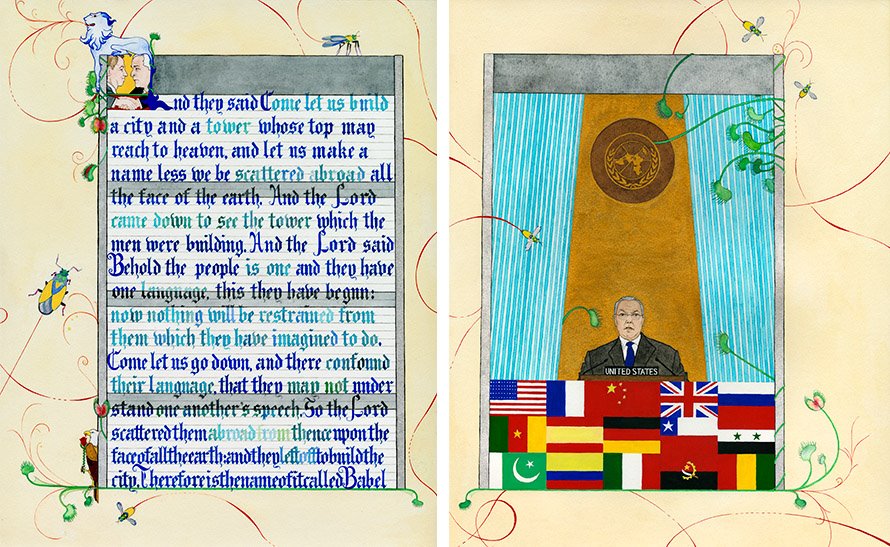
I first encountered several of Rebecca Whipple's astonishing "Language of War" watercolors during a group show at the San Francisco Art Institute last year. The images, which measure about 15x24" - roughly the size of a medieval folio edition of a hand-copied book - were presented in two-page diptychs, without much explanation, in SFAI's peaceful Diego Rivera Gallery, but I found their tenor to be almost uniquely relevant to their topic, the 2003 U.S. invasion of Iraq.

I am afraid to attempt to speak directly to the tone they strike because this is truly a case where images can open doors that words only close. Despite the artist's kind suggestion that she would like to hear what I think of her work ("I already know what I have to say about it," she wrote prior to our Gmail chat interview), for once I will keep my mouth shut and let the images - and our talk - speak for themselves. (Rebecca has graciously granted me permission to post images of her work throughout this post. You can click on any of them to see larger views.)

Whipple, born in Philadephia and now twenty-five years old, recently moved to Paris after earning an MFA from the Art Institute in 2006. She anticipates that "The Language of War" will take another two years to finish; she completes a new piece for the series every one to two months, and hopes to have twenty in the final set. She does not intend to bind the final version, but will seek to publish a reproduction edition (at the original size) bound in book format.

TiP: Tell me about your process in creating these images.

Whipple: With each piece I have some original idea, and work as intuitively as possible. That idea is like a little seed in my head and it usually takes a few weeks for it to develop more, at which point I do some sketches. Often when people see my work they respond to it, because of the detail and precision, as if they are very planned and thought-out pieces. Although each one is thought and rethought, I actually only make very rough sketches to figure out basic compositional elements before moving directly to the piece. Because each piece takes a month to two months to finish my thoughts and ideas change throughout the work, and although I often start from some basic response to a political event, the works accumulate their own meaning. I think that this is an important point because they really become the antithesis of a sound bite - what we are used to as a visual address of these issues.

"Gladiolus," for example, really took on a life of its own. All of my titles reference flowers, and their "meanings," which I've found in online lists of flower meanings. I take a flower whose meaning attracts me and use it in the piece with which I think it functions. In this case I began with the flower Gladiolus, the meaning being "Give Me a Break, I'm Really Sincere" - this is really composed of two separate meanings but using them as if they were connected added a very interesting intonation to me. When I began the piece it was to be of a "red" and "green" zone. From the green zone a media circus would be looking across onto a scene with a suicide bomber. The "green" zone was going to be done in a more western illuminated manuscript style and the "red" zone in a more eastern manner, but the two would intermix. In the end the media circus became a self-portrait, and the suicide bomber never appeared but the title seemed to take on even more significance.

Gladiolus, Give Me a Break I'm Really Sincere

TiP: The intuitive nature comes through, which is one of the things I like so much about your work. It feels almost dreamlike, very open to mystery, while still being very formally structured and also very pointed, as dreams can be. I think this can open a viewer up to your perspective.

Whipple: It is interesting that you say dreamlike. This is critical to me. The work I was doing before this was in response to dreams.

TiP: And the way you reference works on paper - medieval illumination, Japanese prints - feels very textual, which by its nature is a critique of doublespeak. It posits a record of events that has been set down, a world memory, that politicians often disregard by their actions. I am picturing you now with a thick packet of news photos for reference - all of these likenesses. Is the "Delphinium" piece a composition related to a news photo?

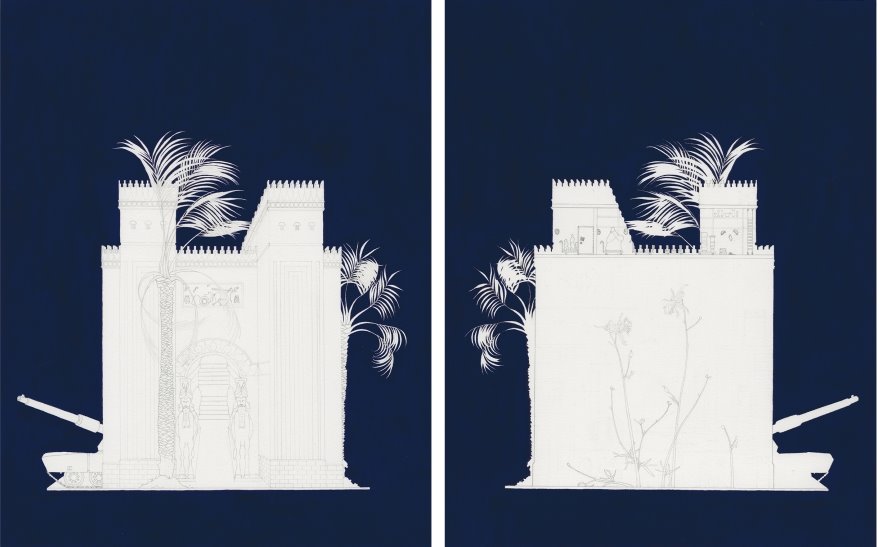
Delphinium, Flights of Fancy, Ardent Attachment - April 8-12, 2003
(Iraq National Museum)


Whipple: Yes, almost every piece uses news photos or just photos found on the Internet. The drawing of the museum came from a picture of the museum with a tank beside it, after the looting. The pieces are really collages. I don't usually think of them as relating too directly to one image.

TiP: Is there anyone whose work helped you better understand how politics could be a part of good art and not just propaganda? I ask because the tension between art and political messages seems so delicate.

Whipple: Yes, indeed.

TiP: I'm trying to understand what makes some politically-charged art so wonderful and why some other stuff will just look like propaganda in ten years. I have some ideas but wonder what you think.

Whipple: Well, to begin with the most obvious, illuminated manuscripts and Indian and Persian miniatures were a huge influence.

TiP: When you look at these influences do you see them as political artifacts?

Whipple: What I love about art and history and art history is being able to explore an old piece and discover how it relates to that time, to what people were thinking about and to the very real and sometimes ugly propaganda that goes on in all times. In other words, yes, sure, why not.

Also, Shakespeare is an influence. I know he's not a visual artist, but I've been very inspired by how he weaves ideas and theories and politics into beautiful and even seemingly fanciful work. These ideas are able to withstand time because they are sewn into the work with great dedication and eloquence even if they are somewhat hidden at times.

TiP: I wonder if the indirectness of some of them is more inviting to the viewer to contemplate - that this helps differentiate it from propaganda.

Whipple: Not necessarily indirectness, as much as not being closed, I think.

TiP: How do you mean?

Whipple: That certain works are more open to the intermixing of concerns. It is not just politics, it is life, it is flowers, it is animals, it is buildings, and they work together somehow and coexist, and dreams, too.

TiP: One piece that I had difficulty engaging with was "Begonia" - the reference to the children's book session was so prominent in Fahrenheit 9/11 that it kind of played itself out for me. This even though it is such a powerful and significant bit of historical information - even though it is so telling - you are somewhat at the mercy of the "rest" of the media in how effective these iconic images can be in your work. Of course, you make them your own as well - Bush's blank expression and profound (Christian-mystical) hand gesture are a briliant combination with his advisor at his ear... Okay, I take it back, I like that one too. Any thoughts, though, about what viewers will bring to your work, and how your interpretation can benefit or be harmed by how fully the images were explored or "used up" before you worked with them?

Whipple: Yes, images are certainly used up sometimes. That piece was one of the earliest and I think it may be a little more naive. However, part of this project is to look at different types of events, used up ones and unused, and to see how they hold weight in our minds and bodies in different ways. What has been exciting to me is how people always respond more harshly to the paintings that have the faces of political figures in them. To me it is a necessity to have them, and I deal with them with great care and concern because I think the specificity is so important. However, people almost always seem to think that the paintings with politicians are more didactic and simple then those without. I tend to disagree, but I think it shows the weight that those images carry.

TiP: You described your process a bit ago. What point are you at now in the one- to two-month cycle of an image? I know you just moved, but I guess I'm asking, are you in the middle of a piece now, or have a "seed"? Can you tell me what it is, what you're thinking about?

Whipple: Well, the move has certainly disrupted my flow. I have a few pieces that I'm thinking about and one that I have almost finished. These pieces are a bit more simple in some attributes, in that I'm working more directly on portraits. The portrait I almost finished is of Donald Rumsfeld. However, I am also in the midst of starting some animation work. It is a different project about which I'm excited and which I plan to work on at the same time as the book.

TiP: Animation! In what format? How produced?

Whipple: Well, I can't give away all my secrets yet.

TiP: Well... hand-drawn and filmed, or Flash, or what? You have to give me something.

Whipple: Okay, hand-drawn. No Flash. When they are further along I can tell you a lot more.

All images in the above post are reproduced with the express permission of the artist and may not be reproduced in any format without her permission. Click here to visit Rebecca Whipple's website, where you can see three wonderful "Languages of War" pieces not shown here as well as her other drawing and painting series.

Tuesday, October 03, 2006

Lessons Learned: An Interview With Artist and High-School Art Teacher Susan Sheets, With Advice For Young And Emerging Artists


Susan Sheets has been a high-school art teacher in the Houston suburb of Spring for twenty years, and is one of a rare few K-12 teachers committed to bridging the gap between teacher and professional artist. Many art teachers have strong desires to express themselves artistically, but the high demands on teachers and the challenges of establishing a professional art career are each so high that it's no surprise that most put off public engagement in artmaking - with all of the showing, self-promotion, and professional expenses - until their retirement.

In addition to teaching painting, drawing, and design classes at Spring High School, Sheets has been awarded several painting residencies, ran a gallery and public studio in downtown Spring, and has shown and sold canvases around the state for the past five years. I thought it would be interesting to talk with her about what led her down this challenging path and what, as an "edge case" between the worlds of art and K-12 education, she had learned along the way.

TiP: Tell me your story about how you got drawn to teaching and to art.

Sheets: As a child I really wanted to build things. No one I knew could help me build birdhouses; but I could create paintings and drawings, so my parents sent me to the museum in San Antonio for art classes. When I was in high school, I had a part-time job at an ice-cream parlor where I earned $1.50 an hour. When I earned enough money, I purchased a little tiny oil paint set. Those were the smallest paint tubes I have ever seen, and I was very stingy with the paint. When I went to college, my father expected me to major in nursing at Baylor University. I dutifully took nursing prerequisites until I discovered I really didn't like anything about nursing. That was when I realized I had to examine my own heart and discover what I wanted for myself. Learning to see "inside yourself" is the first lesson I teach my students.

When I moved forward in my education, I went to several universities, and everywhere I went I was advised to get a career not in art, but maybe in a related field. I majored in Interior Design at the University of Houston. I actually practiced as a designer for the home building industry for ten years, and I was happy as a designer for quite a while. Then I looked at my life again and decided that I should be painting. I went back to school to major in painting this time. Somewhere along the way, I had to support myself and applied for a teaching position. I was hired by Spring I.S.D. on an emergency certification. Back to school again, I took education courses and more art courses until I earned a Masters in Art Education.

TiP: How long have you been selling paintings?

Sheets: I remember selling my first painting for $15 to another student in my class at MacArthur High School. She promptly scratched out my name and signed her own and told everyone she painted it! That was 39 years ago! Although I have been selling now and then for many years, my work really began to sell with some popularity about five years ago. My work was in two galleries here in Houston and the equine art was what pleased me the most and sold well to the public.

TiP: Tell us about the classes you teach, and about Spring High School.

Sheets: When I first began, I was given all Art I classes and one year I even taught an English class. Now I teach advanced classes, but I always have Art I classes too. My classes include Art I, Painting II and III, Advanced Placement Drawing Portfolio, Advanced Placement Two Dimensional Design, and Advanced Placement Art History. I have also taught Drawing II and III, and Advanced Placement Sculpture. There are over 3,000 students a Spring High School. My classes this year are larger than they have ever been before. I have 30 students in the largest class and 16 in the smallest. My students are all levels, 9th grade thru 12th grade.


TiP: Are there unique strengths young people possess when it comes to expressing themselves through art?

Sheets: That seems to be the toughest question yet. Because cartooning and anime are so popular and so strong with young people, it is difficult to move them on to new skills. Praise and awe are heaped on young artists for dramatic anime images they have plagiarized or reconstructed. To find their own expression or their own style, young artists have to give up anime and learn to "see and feel" in the real world. It is simply hard work which requires focus. Focus is the most difficult commodity to come by with constant distractions and instant entertainment always available. Young people do have enthusiasm - lots of enthusiasm. They also have angst - lots of angst. Self-expression is only natural.

TiP: How have your relationships with students contributed to your development as an artist?

Sheets: Because I wanted to be really good at teaching art, I became a good artist. I took my students to figure drawing classes, I drew every assignment I gave my students, I painted, I drew, I demonstrated. I looked for opportunities to improve and I won scholarship to Arrowmont in Gatlinburg Tennessee. I was awarded a scholarship to Milwaukee Institute of Art and Design for a summer course. I went to Ringling in Florida to see printmaking techniques. I took two courses in Savannah at the School of Visual Arts and I attended a summer course at Chicago Art Institute. Then I applied for and was awarded a residency in Wyoming on a two-thousand-acre cattle ranch. I challenged myself just as I taught my students by challenging them.

I also learned unique and wonderful things from them. Two students in particular are notable. One student was my first AP student 10 years ago who was awarded a "full ride" at Maryland Institute, College of Art. Abe was superb in figure drawing. He never did the obvious "pretty" view, but rather found the most awkward or most difficult angle from which to draw the figure. Until Abe came along and taught me something better, I always did the "pretty" view. The second student was a young man with a language disability. He could never compose essays or write even simple assignments, but he could turn a still life into a roller-coaster ride! His sense of space and movement in a composition was truly awesome. Still-lifes were boring until
learned from my student how to show depth and make a composition really work!

TiP: What do you tell students who want to be artists? What advice do you give them? Do you have many students who go on to art schools?

Sheets: I tell students they can be artists, that there is a future for fine artists, but they need to be the best. With an outstanding portfolio and a good GPA, my students can obtain scholarship (a partial or a full ride) to the art college of their choice. During National Portfolio Review, our school is visited by the finest art colleges in the nation, who come to recruit from Texas. Spring High students are among the best! We have Spring students in art universities across the nation. Every year we have three to five students who apply to art colleges and we have had several students who have received "full rides." Unfortunately, we are plagued by the high cost of college education and too often our students return after one year saying they cannot afford the private art schools. Those who do not go on to art colleges, attend local community colleges. They are generally unsatisfied with the art classes there. I am at a loss as to advise those students. Some seek out the Houston Art Institute, but it also seems very expensive to them.

TiP: What is the biggest thing you bring into the classroom as a "working artist" that would not be a part of your teaching if you just painted casually? I'm thinking about things other than technique, which you are obviously very heavily engaged in and which I'm sure helps your students as well. What else are you able to share with your students, either through your conversations with them or simply through your example?

Sheets: I have learned as a "working artist" a number of things unexpected and infinitely valuable.

  • Know how to develop your topic, recognize your "muse" or challenge yourself to create your body of work. Students have to develop their "concentration" for college board portfolios. This is a real struggle for young students, and it was for me as an artist too.
  • Always work from direct observation or your own personal photographs. Work to find your subject. Do whatever it takes to document your subject and create your own images. Research your subject until you are an expert. I travel all over Texas, and anywhere in the United States where I might photograph horses in their natural setting. If someone offers to let me photograph their horses, I always accept. I'll photograph anything else that looks interesting at the same time. Some of my favorite topics have been the dogs or cats or birds that are always around the stables.
  • Have faith that your work is good, maybe even excellent, and can compete nationally. Search out opportunities and apply for schools, scholarships, grants, and residencies. Don't be afraid to accept when an opportunity is offered or awarded. All Seniors are required to enter the National Art Scholastics competition. It is a good experience for them, and they learn how to enter competitions.
  • Be prepared with a portfolio and a body of work to show. This means have slides or images of your work ready to send to competitions or galleries. This requires cataloging and constant photography of new work. Now, I must produce a CD with my work featured so that I can inquire for new representation. I take slides of all of my student's work for their portfolio, but they are responsible for getting copies made for college application etc. Many times I have discovered students have sent off the last slide of their work, and they no longer have the original work to photograph.
  • Have other materials prepared and on-hand. Lately I have been asked for photos of myself for advertisement or news articles. A few years ago, I hired a great photo student at Spring to do a series of photos of me, just in case I might need a portrait. I have been so thankful she made a beautiful series for me. Along with your photo, you need a good "Artist's Statement" and a "Bio." I require my students to write an artist's statement when they enter the National Art Scholastics competition.
I believe by my example, students learn that they are capable of succeeding as fine artists. I recognize such great potential in my students. I know they can be great artists, and they know I believe in them.

All works pictured above are posted with express permission from the artist and may not be reproduced without permission. They are, from top: Stomp, Yard Dog, and Cimarron Wash. You can view these and many other works by the Houston-based painter at her website.

Thursday, September 28, 2006

B Is For Blogged: Steve Mack's Alphabet Book

Freelance illustrator Steve Mack has been posting his way through the production of a gorgeous alphabet book on his Spot Illustration blog, and just posted his "Z" illustration. Mack, who has illustrated childrens' books, designed greeting cards for the major card companies, and contributed illustrations for magazines and books, lives in Canada with his wife Erin and son Alex, and was kind enough to agree not only to do an email interview with Think In Pictures but to send along the above "b-side" drawing for his "L" page, which was replaced by this lion. ("I felt it was too simple. Still a cute image though.")

I loved the idea almost as much as its execution; producing and publishing an alphabet book in serial blog form seems very natural to blogging, and is a great example of how artists can engage viewers by offering free access to their creative work in ways that old-school publishers might assume would dilute a copyright. Mack will soon have a print edition of the book available for purchase through eprinter Lulu.com. If you're interested in buying one, don't worry - I'll remind you!

TiP: There's a very strong historic style that comes through in your work. Can you break that down for me? As an illustrator, what are the features that give it that look we recognize and can unconsciously place?

Mack: I have deep respect for the illustration and design of many illustrators from the 1940s-1960s. A lot of illustration from that period was handled with a keen eye on simplicity of design, form and color. I think those are obviously timeless qualities people recognize and are the ones I focus on mostly in my works.

TiP: Tell me about your illustration influences. Can you name specific people whose work has really inspired you?

Mack: I am influenced by illustrators like Jim Flora, Alice and Martin Provenson, Alain Gree, J.P. Miller, Aliki, Bernice Myers, Aurelius Battaglia, Eric Carle, Art Seiden, Ed Emberly, Harry McNaught, Janet LaSalle, Leonard Weisgard, Mary Blair, Robert Louis Stevenson, Ruth Ruhman, Ryohei Yanagihara, Sasek, Tom Oreb, Tom Eckersley I could go on and on!
Designers like Paul Rand, Saul bass, Alex Steinweiss. I like designers who think in contradictory scale, bold images and limited color palettes.

TiP: I respect that your modifications for Adobe Illustrator are trade secrets, but let's speak more generally about that process. How would you advise young illustrators looking for a textural or "handmade" look to go about developing their own tools?

Mack: Well, we all have our processes and Adobe Illustrator is just another tool. Like paint brush or a pencil. I would tell young illustrators not to let the computer dictate your style. You can bend and pull the software in any direction you like. It just takes a lot of experimenting. Heck! I still experiment every day! That’s the fun of illustrating! If I wasn’t trying new things or if it was some "plug-in" I applied it would be a rather dull existence. I need to feel like I am crafting something not just clacking keys.

As for developing tools to look handmade I would suggest studying natural media. Look at old illustrators work and try and replicate that in Adobe Illustrator by any means necessary. There are hundreds of ways to provide texture in you digital work. It just takes a little bit of experimentation.

TiP: A lot of so-called Modern art emphasized the need for an art form to reveal the essential nature of its medium, but postmodernism seems to have broken up that particular cartel. Would you care to philosophize on the aesthetic of the "fake handmade" - i.e. creating something that is meant to look handmade or textured but is computer-generated and produced using entirely digital means?

Mack: I think that need is just created out of our medium of interaction. As an illustrator I sit down in my home studio and I converse with art directors spanning the globe. I can be in NYC in an instant revising a layout for a book and in the next instant I can ftp greeting cards to art directors in Cleveland then I can reply to a request from Japan. That is pretty amazing magic in my books. Handmade work will never go out of fashion and the computer brings immediacy to any project on many levels. Marrying tradition and technological is getting the best of two worlds for many.

TiP: What did you like best about your alphabet project? What did you find most difficult about it?

Mack: My alphabet project gave me a chance to experiment, have fun and come away with a printed book. I achieved all of those goals and hope it was entertaining. The best part is always reading people's comments. Some of the illustrations I liked lest got some of the best reactions. Funny how that is and I really enjoy when that happens.

I don't think anything was difficult. I completely enjoyed myself!

TiP: Do you have favorite illustrations from the set? Why are they your favorites?

Mack: Sure, I thought alligator was a good one for the textures I used and the boldness of the alligator's shape. I liked O as well for the odd way I colored the tentacles. I like when I do stuff that doesn’t make much sense other than to please my inner designer. That’s the beauty of being your own art director!

That being said I hate B … I got carried away with that one. I lost focus and tried to include too many B objects. I find it breaks format and will be replaced for the published book. So that is an internet exclusive. The replacement will be a surprise for the people who get the book.

TiP: Do you have kids? If so, how old? How much do they engage with your illustration work?

Mack: Yes sir! I have Alex who just turned two and is a ball of sunshine! And my wife and I are pleased to announce we have another bun in the oven.

Being that Alex is only two he doesn’t really get the whole idea of what his daddy is doing. I do get involved with him while he’s coloring at his little desk but I don’t push any art stuff at him at this point.

TiP: The alphabet seems like a great superstructure to hang a lot of visual ideas off of - it gives you a discipline and a very clear direction and goal. Have you thought ahead to any other children's book projects that would give you the same kind of framework for a project? If not, will you miss it?

Mack: Yes, I have some more ideas for other projects based on the blog style of communication. The project was fun so yes, I will miss it.

I read a great quote from Eric Carle once that said: "When I start a book it’s a lot of fun. After a while it is work, then it becomes labor. Towards the end it feels like slavery! After I have delivered the finished illustrations to the publisher, I become sad. But when I see the printed book, I am happy again!" That sums it up nicely!

Tuesday, September 26, 2006

Interview With "Fabric Brain Artist" Marjorie Taylor

Marjorie Taylor is a professor and department head in Psychology at the University of Oregon. I first encountered her "Museum of Scientifically Accurate Fabric Brain Art" after it got the Boing Boing treatment about two weeks ago. I thought they were interesting enough to hassle Taylor for an email interview. Fascinating stuff!

Fabric brain art by Marjorie Taylor (detail)

The whole quilt

TiP: What first inspired you to create these quilts?

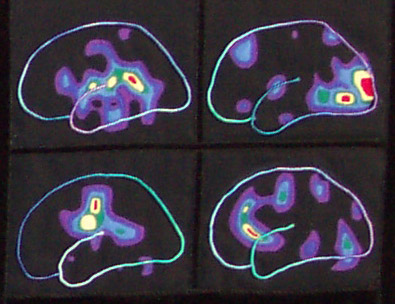
Taylor: I like to work with fabrics and have made about 30 quilts, as well as other projects involving fabric (hooked rugs, needle point, etc.). I like fine detail and enjoy using tiny beads, metallic threads - whatever - to create effects. When people in my department started using brain imaging techniques, I was immediately struck by the beauty of fMRI, PET, and ERPs. I like visual art influenced by scientific images and I thought the folds of the cerebral cortex would look great in velvet.

TiP: Describe the techniques you have used. Quilting, beading, embroidery? Are these present in different combinations in each work? Other craft skills?

Taylor: I use both hand and machine quilting, embroidery, beading, applique and reverse applique. I use the patterns on computer boards as inspirations for quilt lines and electronic pieces (resistors, etc.), as well as different types of beads, as decoration. I particularly like to use tiny mirror pieces because it suggests mirror neurons. The materials are tulle, velvet, silks, satins, cottons, metal netting, and lots of different kinds of decorative threads. Lately, I have been incorporating old computer pieces (core memory) into the designs. Plus I like the look of circuitry diagrams in old texts and use them as well.

TiP: Do you do a lot of crafts, or did you learn these skills in order to do this project?

Taylor: I have always liked to make things.

TiP: What does it mean to you to interpret scientific research through such a traditional craft?

Taylor: It strikes me as funny.

TiP: There seems to be a form of meditation at work here, given that quilting, embroidery, etc. are relatively slow processes, while PET scanning, film development, and even interpretation of individual images are all relatively rapid processes. Is there anything else in your work that offers a comparable intensity of attention, for lack of a better descriptor? Any other thoughts on this?

Taylor: It is true that my pieces sometimes take a very long time. The first one took months because I did not know how to cut the velvet and fold it to make an anatomically correct brain. I made several before I was satistifed with the result. You are right that the process is meditative. It is calming to make fabric brains.

TiP: What are the stories behind the images of your work on the website? Do they reflect particularly interesting brain events or situations, or are they "normal" scans?

Taylor: One of them is based on a scan of the brain of one of the scientists working at the Lewis Center for Neuroimaging at the University of Oregon. I wanted to do a piece with a particular view so I went down to the center and Mark Dow gave me a scan of his brain that I cut up and used as a pattern. In other pieces, I have used scans from published articles in scientific journals. For example, one piece (done in reverse applique) shows PETs for hearing words, readings words, etc.

TiP: Do any of the scans you have recreated come from still-living subjects? If so, have these subjects seen them? What is their relationship to the work?

Taylor: The piece that is based on Mark Dow's brain is hanging in the waiting room of the imaging center where he works. He likes it.

Friday, July 07, 2006

Remixing Science: Michael Paulus' Unnatural Wonders


New work by mixed-media artist Michael Paulus always gets my attention, and he has a new series up in Portland beginning today and running through August 1 (Stumptown, 3356 SE Belmont). The new series, "Ten Commemorative Plaques of Prototypes from the Millenium Bioengineering Conference in Hartford, CT" purports to document "lost" bioengineered species whose prototypes were purloined from a scientific conference. The grace with which he executes his strongest works keep us in that amorphous zone between science and art where anything can happen; in fact, it looks as though it did happen in some lost epoch in which the twenty-first and ninteenth centuries collided. For now Paulus has a couple of the project's ten pieces posted to his website; hopefully there will be more up soon.


I've been a big fan of Paulus' work since I stumbled across his Skeletal Systems series, which imagines the skeletons of cartoon characters from Betty Boop to Shmoo (a detail from Hello Kitty, his first in the series, is pictured above). Paulus' work blends curious concepts with anti-pop craftsmanship using methods and forms that seem at once refreshingly alien and old-world; in his Skeletal Systems pieces, acetate is laid over parchment paper on wood with a faithful rendering of the cartoon character on top and the skeletal structure inferred from their outward appearance, an exercise that renders the cute playfully grotesque and the plastic and Platonic utterly corporeal. I'd show his work alongside Harri Kallio's dodo reconstruction photographs in a heartbeat. Both artists play with our notions of evidence and authority and our fantasies' guerrilla war against it all - Paulus by directly referencing formalisms of the grand 19th-century style of scientific display and edification, Kallio striking at the heart of the matter with his reconstructions of the tragic icon of the naturalists who handed that style down to us.

"I liked the idea of representing these characters from a physical point of view, as though they truly existed with those features," Paulus said in an interview in Pig magazine last year (Italian, my translation). "So I decided to investigate 'clinically,' in a more or less objective way, the structure of some of these characters as though I were a scientist with a living organism that presented particular characteristics. I did it to capture their essential nature and to see them in a new light."

One interesting outgrowth of Paulus' "Skeletal Systems" work was that the artist worked with a profoundly hip middle-school teacher in Oregon who asked him if he'd mind if she used his artworks as inspiration for her students to draw skeletons for the cartoon character of their choice. Kids spent time prior to the activity learning the bones of the human body and attempted to incorporate them into their skeletal drawings of characters ranging from Homer Simpson and Pluto to the teacup from Beauty and the Beast. Below, from Paulus' website, is a grading rubric the teacher created for the activity (click on it to view it at a larger size).

"The interaction with the students was great," Paulus told me in a response to some questions I emailed him yesterday. "Actually the teacher, Mrs. Duncan, contacted me and asked if I would be open to her students using the skeletal systems model I had done for their science class dealing with the human anatomy - specificaly the skeletal system. I received a handwritten letter from every student and a xerox of each student's work. I love them. I have them all." You can view some of the student drawings and letters here.

It's easy to forget the role of imagination in science, and despite artists' frequent plundering of the riches of recent discoveries, little traffic goes the other way. Bringing art into the science classroom - whether it be to approach learning from a different perspective or simply to show how scientific knowledge is "remixed" by contemporary culture - can help bridge that mental gap for all kinds of learners.

Here is what my fantasy high-school science teacher would assign as homework:

View the selection of works from Michael Paulus' "Commemorative Plaques" series and answer the following questions.

  1. What concerns about genetic engineering does the artist raise with his work? What tone does Paulus use to express his concerns? What reaction does he hope to achieve in viewers?
  2. What safeguards does the scientific community hope will prevent Paulus' worst fears from being realized? What are the limitations of these measures?
  3. (After a class discussion.) With Paulus' work in mind, draw your own genetically engineered life form that represent your own concerns about the future of bioengineering. Write a paragraph comparing the two creatures, explaining how each reflects the tensions between scientific progress and a respect for the natural world.
Lesson extension: Shop class.

Sunday, December 31, 2000

Appendix A: Interview Transcript with "Language of War" Painter Rebecca Whipple

This interview transcript is a raw version of the interview published here, and was inspired by this piece about interviewing via Google Talk and employs a few techniques I confessed to employ in this post about interview editing.

5:19 AM Rebecca: Hello Jeremiah
5:22 AM me: hi rebecca!
give me one sec.
Rebecca: okay, take your time
5:23 AM me: I'm going to close this chat to make sure it's saving the transcript to my chats section without me having to do anything special. Then we can start chatting again, okay?
Rebecca: sounds good
5:24 AM me: okay, it seems to work fine.
5:25 AM how are you?
Rebecca: I'm doing well, I've just finished a week long painting project
me: what kind of project?
5:26 AM Rebecca: sorry
my chat was doing something strange
I couldn't send
it was painting my new apartment!
5:27 AM me: ha ha
Rebecca: it takes a different kind of talent
ha
me: where in france are you living?
Rebecca: I'm living in Boulogne-Billancourt, a suburb of Paris that borders the 16th
5:28 AM In a few weeks I'm starting a teaching assistantship through the government
5:29 AM It's teaching english, but it's part time which means I will have plenty of time to paint
me: what brought you to paris? something external (marriage/relationship/job) or jus tthe desire to be there as an artist or a human being?
5:30 AM Rebecca: Well, I would wish I could say it was just some burning desire, but no, it's a boyfriend
me: what is he doing there?
5:31 AM Rebecca: He's doing his Masters in English and American Civilization, he's from here
we live just 20 minutes from his parents
me: i'm guessing you share views about the Bush administration...
5:32 AM Rebecca: we aren't on opposite sides of that many political arguments
It is interesting to be here because they are coming up on a presidential election
and one of the candidates is very pro USA
5:33 AM me: I suspect you could find a gallery interested in showing your work there?
Rebecca: There seems like there will be a lot to watch
5:34 AM I hope so, at the moment I'm still just setting up basic living things but I plan to look for a gallery
I'm also hoping to check out Berlin and London
Yes, there will be a lot to watch
me: connecting with the professional art community can be different in a different culture, esp. with a language barrier - but I think your work translates very well!
5:35 AM Rebecca: As I understand more it will get more intrigueing
me: its concerns are global.
Rebecca: thanks
Yes, it will be a challenge
but I think it will be fun to see what the art world is like here
5:36 AM I've heard that in Berlin, at least, things are a bit more open and welcoming but also that that is changing
In the United States galleries still seem to be afraid to put anything with a political face on their walls
5:37 AM that same concern may work for my benefit here
me: well let's talk in some detail about your recent work. tell me about the finished book. how many pages? did you actually bind them?
and what is it called?
5:38 AM Rebecca: Well, the book is not yet finished. I believe it will take another 2 years to finish. It is called The Language of War, and I AM hoping to have about 20 pages in all
5:39 AM Also, it will never actually be bound in the original version.
The only bound versions will be a reproduction of the exact same proportions as the original works
me: tell me about your process in creating these images.
5:41 AM Rebecca: With each piece I have some original idea, I work as intuitively as possible. That idea is like a little seed in my head and it usually takes a few weeks for it to develop more, at which point I do some sketches.
5:43 AM Often when people see my work they respond to it, because of the detail and precision as if it is a very planned and thought and rethought piece. Thoough it is thought and re-thought I actually only make very rough sketches to figure out basic compositional elements before moving directly to the piece.
When I begin drawing on the actual paper there is still a lot of room for innovation and change.
5:44 AM Because each piece takes a month to two months to finish my thoughts and ideas change throughout the work
5:45 AM Though I often start from some basic response to a political event, the works accumulate their own meaning. I think that this is an important point because they really become the antithesis of a sound bite
me: The intuitive nature comes through, which is one of the things I like so much about your work. It feels almost dreamlike, very open to mystery, while still being very formally structured and also very pointed. I think this can open a viewer up to your perspective.
Rebecca: ...what we are use to as a visual addressing these issues.
5:46 AM Thank you, it is interesting that you say dreamlike. This is critical to me.
5:47 AM The work I was doing before this was in response to dreams
me: Yes, and the way you reference works on paper - medieval illumination, japanese prints - feels very textual, and in that sense a condemnation of the sound bite and of the fast-talking, deny-it-later mentality of much of government propaganda (gee, thought I'd make it through more of this interview before using that word...)
I did see those drawings on your website I think.
5:48 AM Rebecca: Yes, and I have plans to start up a new project that will combine some of those ideas with approaches in my current work.
5:49 AM Yes, the propaganda. Well, the piece Gladiolus is the one that most pointedly addresses the question of media
me: The mere presence of symbolism also suggests dreams, I think, and some of the titles of your pieces are also very suggestive of that. What, for example, is the intended meaning behind the title of the Gladiolus piece - oh, you're writing about it now!
5:50 AM Rebecca: Well, this piece really took on a life of it's own.
7 minutes
5:58 AM Rebecca: All of my titles reference flowers, and their "meanings," which I've found in online lists of flower meanings. I take a flower whose meaning attracts me and use it in the piece with which I think it functions. In this case I began with the flower Gladiolus, the meaning being "Give Me a Break, I'm Really Sincere" these were really two separate meanings but using them as if they were connected added a very interesting intonation to me. When I began the piece it was to be of a 'red' and 'green' zone. From the green zone a media circus would be looking across onto a scene with a suicide bomber. The 'green' zone was going to be done in a more western illuminated manuscript style and the 'red' zone in a more eastern manner, but the two would intermix. In the end the media circus became a self-portrait, and the suicide bomber never appeared but the title seemed to take on even more significance.
I don't know if that answers your question.
5:59 AM me: the right panel of that image is very haunting - with the streets completely deserted, and the awning of someone's fruit stand kind of falling down.
6:00 AM it looks like a place where people are afraid to be - everyone except the Americans.
by which I mean the military.
Rebecca: Yes, I could only manage to put animals there.
The people didn't want to be there
6:01 AM me: the venus fly-trap was the only botanical symbol that seemed straightforward. let's see, what were the others...
i'm going to call up your website while we chat.
Rebecca: Okay
I have a strict titling system from which I vary
6:02 AM The base is a flower's name, it's meaning and a date; however, in Gladiolus there is no date and in Victory there is no flower.
6:03 AM I must admit, I think that the Delphinium title is not complete on the website.
6:04 AM me: so the date is... completion? or a tag related to an event?
Rebecca: The full title is Delphinium, Flights of Fancy, Ardent Attachment - (The Iraq National Museum) and the date of the looting, which I can't recall right now (my brain is a sieve.)
6:05 AM The last line is the answer to that question
me: I am picturing you now with a thick packet of news photos for reference -- all of these likenesses. is delphinium a composition related to a news photo?
6:07 AM Rebecca: Yes, almost every piece uses news photos or just photos found on the internet. The drawing of the museum came from a picture of the museum with a tank beside it, after the looting.
The pieces are really collages.
I don't usually think of them as relating too directly to one image.
me: do you keep these reference materials? do you have a source I could look at for that delphinium image? I think that would be a really interesting view of the "pre" part of your process.
6:08 AM Rebecca: I pick and choose what I need and want to use.
Well, moving means I had to throw out a lot of the images I had printed out, but I'm sure I can find the web reference and send it to you.
6:10 AM me: There is a strange sense in which these pieces suggest that this whole process - this whole history - is in a sense imaginary. A fantasy. The running legs of Iraqis who have been blown apart by bombs... the smiling animals... the planes just floating over that scene.
6:11 AM Rebecca: There is a miny project I've started which is not in it's completed form but may be of interest to you. At the bottom of any of my web pages you can find a "links" link. If you click that it will take you to something called "Cross Section of a Painting."
me: It's very disturbing in the sense that it is lyrical and indicts by the style in which it portrays the horror.
I saw that but can't make it work!
6:12 AM I use Firefox and all I see are the labels and lines, no picture.
Rebecca: Oh really?
me: I haven't tried it in Internet Explorer...
I will after we are done and see if I can see it.
Rebecca: yeah, that's the problem
I have to fix it but have been busy
the code is different
me: Do you code your own website?
Rebecca: Try Safari or IE
it should work
yeah
6:13 AM When I first decided I wanted to be an artist, seriously, I thought I should learn computers a bit, so I would have a "real" skill.
6:14 AM But, I enjoy doing it, and computers are becoming more and more important to my work.
It is funny, because I am working with things that are very fast and things that are very slow at the same time.
6:15 AM I enjoy it, I feel like I'm on the border of two eras.
me: I have about 10 more minutes so wanted to make sure to get a few more questions answered. First, basic details: Where are you from? How old are you? How long do you plan to be in France?
6:16 AM Rebecca: Okay. I was born and raised in Philadelphia, PA. I'm 25 years old and am not sure about the duration of my stay here in France.
me: are there contemporary artists who have inspired you to take on political topics - others who, in your opinion, do this very well, and in a way that is relevant to your thinking or your work?
6:17 AM Rebecca: Hmm, well one of the inspirations for my beginning this work was Jeff Wall, and his piece "When Dead Soldiers Talk," forgive me if the title is off.
6:19 AM Besides Jeff Wall, there have been many other artists who inspire me in one way or another, but like my work, the inspiration is more of a collage than necessarily a direct link such as "this one artist does great political work."
me: a wonderful piece, thanks for the reference.
6:20 AM what about historic political art? anyone whose work helped you better understand how politics could be a part of good art and not just propaganda?
Rebecca: Sure.
me: I ask because the tension between art and political messages seems so delicate.
Rebecca: Yes, indeed.
me: I'm trying to understand what makes some politically-charged art so wonderful and other stuff will just look like propaganda in 10 years. I have some ideas but wonder what you think.
6:21 AM Rebecca: Well, to begin with the most obvious, illuminated manuscripts and Indian and Persian miniatures were a huge influence.
me: when you look at these influences do you see them as political artifacts?
6:22 AM Rebecca: What I love about art and history and art history is being able to explore an old piece and discover how it relates to that time, to what people were thinking about and to the very real and sometimes ugly propaganda that goes on in all times.
Yes, sure, why not.
Also, Shakespeare.
me: yes, a great example.
6:23 AM Rebecca: I know he's not a visual artist, but I've been very inspired by how he weaves ideas and theories and politics into beautifual and even seemingly fanciful work.
6:24 AM These ideas are able to withstand time because they are sewn into great dedication and eloquence even if they are somewhat hidden at parts.
6:25 AM me: I wonder if the indirectness of some of them is more inviting to the viewer to contemplate - that this helps differentiate it from propaganda.
6:27 AM Rebecca: Not necessarily indirectness, as much as not be closed, I think.
being closed, excuse me
me: How do you mean?
6:30 AM Rebecca: That certain works are more open to the intermixing of concerns. It is not just politics, it is life, it is flowers, it is animals, it is buildings, and they work together somehow and coexist.
6:31 AM and dreams too...
me: one piece that i had difficulty engaging with was begonia - the reference to the children's book session was so heavily played in Fahrenheit 9/11 that it kind of played itself out for me. This even though it is such a powerful and significant bit of historical information - even though it is so telling - you are somewhat at the mercy of the "rest" of the media in how effective these iconic images can be in your work. Of course, you make them your own as well - Bush's blank expression and profound (Christian mystical) hand gesture are a briliant combination with his advisor at his ear... okay, I take it back, I like that one too. Any thoughts, though, about what viewers will bring to your work, and how your interpretation/reinterpretation can benefit or be harmed by how fully the images were explored or "used up" before you worked with them?
5 minutes
6:36 AM Rebecca: Yes, images are certainly used up sometimes. That piece was one of the earliest and I think it may be a little more naive. However, part of this project is to look at different types of events, used up ones and unused and to see how they hold weight in our minds and bodies in different ways. What has been exciting to me is how people always respond more harshly to the paintings that have the faces of political figures in them. To me it is a necessity to have them, and I deal with them with great care and concern because I think the specificity is so important. However, people almost always seem to think that the paintings with politicians are more didactic and simple then those without. I tend to disagree, but I think it shows the weight that those images carry.
6:37 AM me: you described your process a bit ago... what point are you at in the one- to two-month cycle of an image? I know you just moved, but I guess I'm asking, are you in the middle of a piece now, or have a "seed"? Can you tell me what it is, what you're thinking about?
6:40 AM Rebecca: Well, the move has certainly disrupted my flow. I have a few pieces that I'm thinking about and one that I am almost done. These pieces are a bit more simple in some attributes, in that I'm working more simply on portraits. The portrait I am almost finished is of Donald Rumsfeld. However, I am also in the midst of starting some animation work. It is a different project about which I'm excited and which I plan to work on at them same time as the book.
6:41 AM me: animation!
in what format?
Rebecca: Yes!
me: how produced?
Rebecca: Well, I can't give away all my secrets yet.
me: Well... tell me, hand-drawn and filmed, or Flash, or what?
6:42 AM you have to give me something....!
Rebecca: Hahaha. Okay, hand drawn.
No flash.
6:43 AM When they are further along I can tell you a lot more. I promise.
6:44 AM Well, it may be time for me to go now. This has been very fun.
Do you have any last questions?
me: No, it's been wonderful. Your answers have been very thoughtful.
6:45 AM Rebecca: Thank you. I will now tell everyone how wonderful it can be to do a g-mail chat interview!
me: I will create an edited draft and then send it to you for your review. Some of the basic facts you've given me will be worked into a text about your work, and the commentary will be tightened up and "un-chatted" a bit. But I will let you vet the final format.
Yeah, it's an interesting format... kind of fast/slow.
Rebecca: Yes. Okay, I'll look forward to the draft...
6:46 AM me: Have a good day and I'll be in touch in a few days. Can I have pre-approval to put up to 2-3 images of your work into the interview?
Rebecca: Of course!
me: Cool. Okay, talk to you later. Enjoy paris! I lived there for a month once... So much great medieval work there. Have you been to the Cluny yet?
Rebecca: A bientot (while in France.)
6:47 AM All I've been doing is painting but I can't wait to explore.
I'll check it out...
All the best.
me: Okay, okay, I know you have to go. Thanks for your time! - Jeremiah
6:48 AM Rebecca: Sorry, didn't mean to cut you short, we'll talk more about France later, okay?
me: no problem - it's time for me to get ready for work in the USA. Bye!
Rebecca: Bye!