
Showing posts with label comics. Show all posts
Showing posts with label comics. Show all posts
Friday, July 27, 2007


Saturday, May 26, 2007

Friday, May 18, 2007
Friday, May 04, 2007
Free Comic Book Day Tomorrow
Friday, April 13, 2007
Dan Goodsell Interview
 There's a great interview with Dan Goodsell, the tireless artist behind Mr. Toast and his "immersive world," on Old Man Musings. I have admired Goodsell's work for a while, and included him in a recent post on Z Recommends about artists to collect for young children. So I was pleased to have the chance to learn more about him. In the interview he cites his influences:
My childhood heroes were Dick Bruna (Miffy books), Ed Emberley (drawing books) and Bill Peet. Dick Bruna gave me my love of line. Ed Emberley taught me about the creation of worlds and populating them. Bill Peet taught about story and context. I didn’t know I was learning these things when I read their books as a kid but looking back as adult these are the things I strive to accomplish in my work.All three have a ton of stuff online if you aren't yet familiar with them:


Goodsell later cites Harry Nilsson's film The Point as a major influence, which is a favorite of mine as well. The video segment from the film's song "Think About Your Troubles" was featured in Z Recommends' Toddler Arthouse Cinema last year in a set of music videos, along with videos for songs from Royksopp and Minilogue. You can watch them all here; the animation for the Nilsson film is brilliant. Who knew a decomposing whale could be so beautiful?
Visit Dan Goodsell's blog and website to see his unique work.
Monday, April 09, 2007
Monday, March 26, 2007

Tuesday, March 13, 2007
Kevin Huizenga
 Kevin Huizenga has some great comic originals for sale, with prices from $80 to $200. The gallery view isn't a bad way to browse some of his work. Above, one of my favorites. [Via|Link]
Friday, March 09, 2007


Thursday, March 08, 2007
ComicJuice: Or, Steven Witten Is A Genius
Steven Witten, who created this truly amazing LineRider video, completed work on the program demo'd below, ComicJuice, four days after the idea occurred to him.
Check it out here.
Thursday, January 18, 2007
Top Ten Worst Comic Book Superheroes
An amazing assortment of terrible superhero ideas from Pop Culture Addict. If you are into comics history you may have heard of some of these creations. If not, you may spit coffee when you see these. A couple of personal favorites:
 Matter Eater Lad
 Matter Eater Lad


Wednesday, August 30, 2006
Notes On The Prehistory of Speech Balloons

One of my favorite blogs, Drawn!, recently pointed to cartoonist Andy Bleck's great "Evolution of Speech Balloons," just one of the many interesting sections of Bleck's website. The page is a great introduction to the concept that speech balloons as we know them evolved over centuries, and from other forms which lack the explicit structure but serve the same purpose, namely strings of text emerging from people's mouths (since the Middle Ages) and scrolls and banners which serve the same purpose. Bleck does a good job tracing the rough contours of this development, but the site reminded me of a couple of related artifacts which I think can broaden the discussion of what speech balloons are and where they came from.
I. Text Scrolls and Magical Writing
In the Western art tradition, there is an interesting gap between how speech has been rendered in images prior to and after the dawning of the Enlightenment in Europe. With the widening distribution of the printing press in the sixteenth century, newspapers flourished, and visuals were a powerful way to increase the density of information in a picture, which often was used instead of a written text. Such images can capture a whole host of its creator's observations on the web of interests and perspectives or of simple facts about an event that would otherwise be offered, far less efficiently, in a block of text.
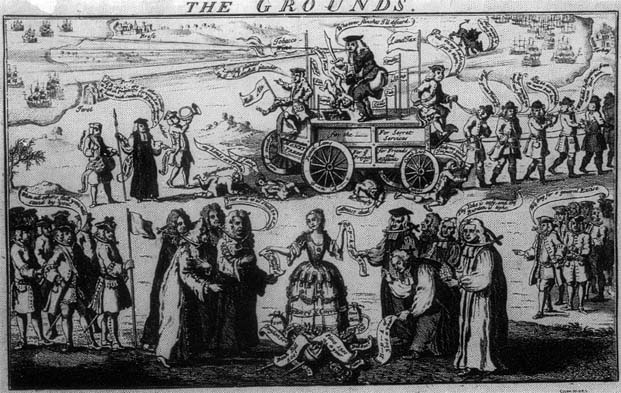
The above 1741 illustration by Nathanial Parr (taken from Bleck's own History), offers a chaotic hint of both the rise of an age of information - of the cataloguing and indexing and reporting that would permeate the public sphere and digitize itself by the late 20th-century - and of the 18th-century rise of the modern novel, with its emphasis on multiple characters and on their perspectives and role in events. But more than anything, it's the former that strikes me; illustrations like the one above remind me more of survey results, bar charts, and other data visualizations than of a proper comic panel, more like a newspaper infographic or one of Harper's information-rich Annotations than today's comic strips. True, the text is ascribed to individual voices, but the field is a landscape in which to make an argument, not a vehicle for telling a story.
A dramatic rise in literacy rates over the previous century had prepared audiences for the use of text as an explicit and direct source of such information, and the Enlightenment use of extensive text in cartoon form represented the full domestication of written text that accompanies such a change.
For this reason, I find pre-Enlightenment examples of speech balloons, or their various permutations, to be even more interesting than the modern form. In the centuries leading up to those first balloons, much of Europe was non-literate, and the many examples of text scrolls and banners emerging from the mouths or hands of figures from Renaissance and earlier artworks addressed a population with miniscule levels of literacy. The question is, were artists speaking to that tiny privileged class which possessed the ability to read, if not write, simple declarations, or were they somehow speaking through their use of words to a public that could not read what they had written?
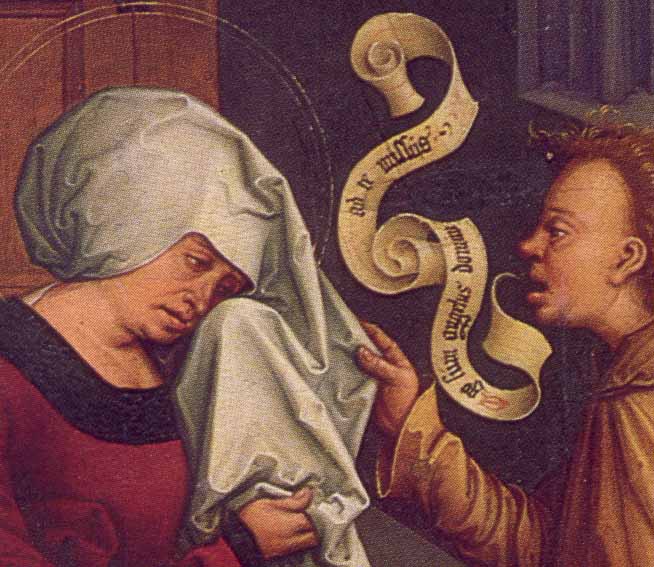
Above is one of the many quite gorgeous examples of scroll speech that Bleck highlights on his site. I don't remember the artist, but I do know that it is a painting of St. Anne, and I probably would not be wrong in guessing that she is being told something very important by the figure next to her, and that that figure is an angel. If I were wrong in that guess, I would be right most of the time under similar circumstances - it is frequently angels who do the talking in such paintings, and they are usually announcing something very important to a human, who is highly unlikely to have a response displayed unless they are a saint. I have seen many annunciation scenes - images that depict the Biblical announcement the angel Gabriel gave to Mary during her pregnancy with Jesus of Nazareth - in which Mary responds with statements attributed to her in the Biblical account.
This brings up a highly relevant, if obvious point regarding such paintings' effect on a nonliterate audience: If they couldn't read the text in the painting (and most of them could not), they couldn't read the book the text came from, either. The use of scrolls in this context, which are repeated again and again throughout these periods' religious artworks that depict man's intersection with the divine, reference not just words but the textuality of those words (that is, their printed nature) in almost every instance. It is almost as though the words are being transcribed for all time as they are spoken - or, to look at it another way, it makes the case that cultural stories which were shared orally, written down, amended, adjudicated, and copied over the course of centuries were preserved with absolute reportorial accuracy. I believe this is not a claim peculiar to the Catholic church or to religion, but reflects a pre-Modern (primitive?) cultural understanding of history. Further, as much as the dominance of images in Church teaching allowed for the illiterate masses to understand and appreciate stories from a book they could not read, the presence of text in such images preserved a crucial interpretive role for the priest and reminded viewers of the significance of the text from which their priest's orders and invocations were handed down.
But the uses of text in such imagery gets even more interesting. While briefly living in Paris several years ago I was in the habit of carrying a journal with me as I visited many of the city's astoundingly good museums, and one of my favorite haunts was the Musee de Cluny, Paris' civic storehouse of all things Medieval. The collection includes old capitals from at least one Romanesque church that was destroyed, which feature wonderfully deep relief and a slight wraparound style that links four related scenes together in a four-panel Romanesque "comic strip." Here is one from the excellent Cluny website; some of the best ones, though, don't have panel dividers like the column here, but actually have figures from one scene rubbing elbows with ones from the next:

One piece in this collection contributed to major changes in my thinking regarding both the degree of personal artistic expression in Romanesque sculpture and in the quality of visionary experience. I am very glad now that I sketched it, because in preparing for this post I could not find a photograph of it anywhere, so the sketch below will guide us here.
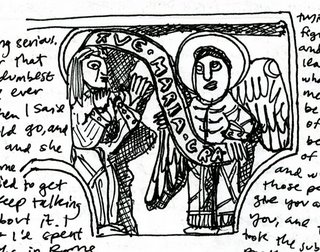
It is an annunciation, and I first took note of it because the angel's scroll is emerging in an interesting, parlor-trick sort of way from his left hand, rather than from his mouth; I suspect this was a convenience of the small "canvas" of the capital face more than anything else. But as I began drawing it I discovered the most fascinating thing about this relief, an interpretation I have seen hinted at a couple of times but never again this directly: The scroll declared by the angel is feeding directly into Mary's head, like a fax machine or a mail slot.
My interest in this aspect of the carving was twofold: First, it represents very skillfully the position that Mary was a passive recipient of information passed to her by an angel, in whose presence she was presumably in awe. Second, it alludes to the annunciation explicitly as a "voice in the head," a vision which to a contemporary viewer could be interpreted as a purely psychological experience. In an age that is both postmodern and post-Mulholland Drive, the blurred line between what is experienced on a personal level and what is corporeal is easy to appreciate, and the distinction less than crucial. Why, one might argue, would a diety who wished to communicate with a human need to visit them in the flesh, when its total control over human perception could allow it to do the same on a non-physical plane? The difference can only matter to an outside observer, not to the recipient of the vision.
I have seen very interesting descriptions of the ways artists have customized speech balloons to communicate specific things to their audiences. (Wikipedia has a great section in their Speech Balloon entry that offers many examples.) It is interesting to reflect on how artists were doing this even a thousand years ago through religious art, as well as on how our culture continues to label things in site-specific and context-rich ways to similar effect.

II. Pre-Columbian Speech Balloons
Another area that Bleck's history could address if it attempted to catalogue instances more than trace an evolutionary path would be the use of proto-speech balloons in pre-Columbian America. The Mayans (and others, I'm sure) used wispy tails to link ideograms to speakers; I don't read the stuff, so can't determine whether this reflects conversation or merely authoritative authorship. (Anyone?)

The Aztecs had a lovely tradition of using small "commas" of breath to designate speakers. In this case, ideograms are positioned outside of the picture, so I'm not sure if the ideograms are thusly tied to a speaker, or if it simply describes events (most of such documents are historical or mythic) with the speaker's speech being an important part of the action. It's an interesting solution to the problem of large-scale scenes with many actors rendered in a simple style that must recognize the importance of speech as an event or action that plays an important role in a story - with the content of the speech detailed elsewhere or perhaps not at all, the speaking itself being of primary importance (in the context of intertribal negotiations, for example, where any diplomat can tell you that the important thing is to get and keep enemies talking).
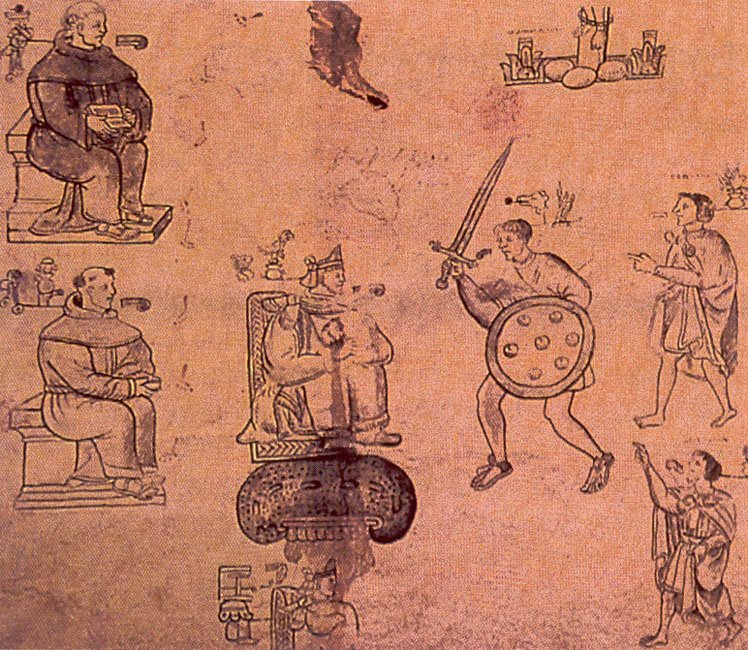
In looking at some images from the Codex Mendoza recently, however, I noticed that such "breaths" are also used in images that show the appearance of a godhead from an altar:
 Does this mean that the "breath" indicates merely sound, or that the appearance of the god is accompanied by commands, instructions, or other statements from the godhead? Any guidance from knowledgable readers would be welcome.
Subscribe to:
Posts (Atom)


