SHOW ME

Monday, July 31, 2006

Sparklines: Handle With Care

Dan Russell from the Creating Passionate Users blog got me hooked on Juice Analytics after he noticed me blogging a bit about visualizing the passage of time using Microsoft Office software, and about his "dot-plot" exercise in particular. Since then I've kept up with their blog, and some of their public-oriented posts about analytics play very well in Peoria, by which I mean they are intelligible and useful to people like myself who are more or less brine shrimp when it comes to statistical analysis.

So I've been reading the JA blog for a while, and they've been talking a lot lately about their hiring practices and management philosophy, and, fickle blog-reader that I am, I was starting to wonder if this really was a feed to grow fat on. Then they posted a nice little visualization in Excel that made me very happy.

If you've spent any time writing Excel formulas, this should make immediate sense:


If the way they wrote this formula doesn't immediately strike you, head over to their blog and let them walk you through it - it's extremely simple and this technique has many fabulous applications. Most importantly, it does exactly what a visualization embedded in a data table should do: It makes the data easier to understand than text alone.

This is a loose application of the concept of "Sparklines" developed by information designer Edward Tufte. These "mini-charts" - "intense, simple, word-sized graphics," as Tufte describes them - offer tiny snapshots of graphical data that look like they should be cut out and pasted to the wall of a dollhouse home office. While they have many useful applications which allow for quick comparisons and for the insertion of chartlike objects into tabular data and even into blocks of text - even statistical analysis has its faddish behavior. Since many have sung their praises and some now seem eager to apply Sparklines to every imaginable dataset, I'd like to offer some observations to accompany Tufte's own suggestions regarding the care and feeding of Sparklines.

1. Sparklines often suffer from isolation. Single charts, or groupings of charts which (a) measure different things and (b) use different scales, lose considerable value without x- and y-axis values. Information Aesthetics should certainly be excused for using these -
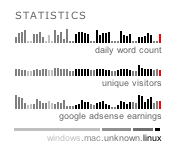
- and there is a tiny thrill at seeing so much data compressed so tightly. But without a scale to hang your hat on, there's little of real value here. The unique visitor graph is meaningless without an x-axis (the date) which would allow for some interpretation of what new content readers found interesting, and without a y-axis ($ values) the advertising revenue chart is meaningless as well (assuming I cared about this in the first place). At least with the word count chart I can see what days the bloggers take off, and I could see further utility in offering paired metrics of word count and the number of posts per day; this would tell you, at a glance, the depth of content on the blog and thus whether it was more concerned with sharing links to other sources or offering its own analysis, or, to put it differently, whether it took on the role of a hub or a spoke. As they stand, however, these Sparklines, with the exception of the OS indicator, are the statistical equivalent of Pop Rocks.

2. Some audiences demand more complexity. Fans of Tufte should know this well from his critiques of PowerPoint, which he argues is not a design space suitable for representing any serious data; his critique centers on how much information is lost in translation as business and scientific reports move from paper formats to PowerPoint slides. Sparklines come with related baggage - they strip data of much of its detail, and this tradeoff must be acknowledged and the cost-benefit ratio assessed. Juice Analytics posted a sample Sparkline application back in January that was highly illuminating to me, although not in the way the author intended. Titled "Restoring Romance to the Sports Page," a Sparkline enthusiast saw a self-evident case that turning this

into this

would be a boon for sports fans. Anyone can see that here Sparklines offer great visual depth at a very low mental processing cost - it's a great way to compare team records in a qualitative way, and even offers chronological data that a win-loss record does not, identifying good and bad streaks over the course of a season. More generally, the attempt is interesting because it reminds us of how much chronology is lost, and how useful that timeline is, when discussing aggregate statistical data for players, teams, and leagues over the course of a season. But the data offered in the simple table is not being respected by this suggested change, and I suspect serious fans - by which I mean people who regularly study the statistics provided in newspapers - would be dissatisfied with the change, and not merely on the grounds of tradition.

I'm not much of a sports nut, but I've known enough of them to know that they have a couple of needs that this sparkline fails to satisfy. I also believe there are many audiences for which similar or additional criteria are poorly served through the use of Sparklines.

First, they do independent analysis, based on their own criteria, using the statistical data. Stripping out the home/road rankings takes an explicit side against the psychological analysis fans regularly engage in; using Sparkines, one source of the Celtics' biggest problems in the sample season above becomes invisible. As a longtime San Antonio Spurs fan, I can attest to the "romance" of a team's divergent win-loss records on and off the home court; it offers solace when a team is down, has predictive power when a team is up, and even, at least in terms of "romance," is a major player in the anticipated, if not real, outcomes of national titles, where a series of seven games comes down with statistical certainty in favor of one team or another based on the complex and highly individualized metric developed by every fan, and of which the home/road records are at a variable of variable importance. {Addendum: Chris Gemignani wrote in from Juice Analytics to point out that their Sparklines example also failed sports fans in its disregarding of relative team standings. Good point, Chris!}

Second, the method by which they communicate this information is verbal, not visual. Numbers can be easily verbalized by humans, while Sparklines would require beat-based or musical interpretation. As much as I'd like to see tailgaters comparing opposing teams' records using an elaborate system of chest thumps or boardroom executives singing lilting arias to each other in the elevator to review stock prices, in terms of practicality, numbers win. In some cases, the best application of Sparklines is in supplementing, not replacing, other means.

None of this is intended to suggest that Sparklines are not useful; indeed, their overextension may be the natural result of the obvious, instinctual, and dramatic utility that accompanies truly innovative ideas. But I do believe that when the dust settles from this discovery, they will be implemented with greater care.

That being said, there are a couple of great resources now that can help you produce your own Sparklines. Bissantz has developed a custom bar-graph font and MS Office Add-In that can generate Sparklines from statistical data, and LodgePhoto has written a script that can create Sparklines in Photoshop from data stored in text files; I'll be playing with both of these as I attempt to make sense of the results of a survey I am conducting of blogs hosted on Blogger.

If anyone else has seen additional critiques of the limitations of Sparklines, I'd love to see them - I found nothing to moderate their well-deserved praise. I may amend and add to this post as I or others develop additional points of critique, but I will always give credit.


Friday, July 28, 2006

Jill Greenberg and the Short, Fat Tail


The mainstream media inexplicably clued into Jill Greenberg's "End Times" series a few days ago (ABC News actually called the show, which opened in April and closed in early July, a "new exhibit" in their ABC World News article yesterday). It reminds me of the time about a month ago when I was watching CNN in a hotel room and saw them do their take on the "Cable Guy" video (repair guy videotaped sleeping on couch after waiting on Cox repair-guy hold for over an hour) when the video had already been downloaded by every 18-to-24-year-old in the English-speaking world and the "story" was a month old. Mainstream news outlets generally hold bloggers in disrepute yet rely heavily on them for their pop-culture news, which might sound contradictory but I guess is just savvy strategy. The fewer regular blog readers there are, the longer they have to prepare their institutional take on a story. By rolling it up in the "blog controversy" wrapper they have the opportunity to regurgitate the issue, throw in a little Mrs. Dash and call it fresh-baked.

For those who complained in the past that the blogosphere lacked a coherent "pro" side to the debate, after pointing out the obvious reasons - we're an opinionated bunch, the "pro" argument is the technical quality of the work itself, and hey, the work is morally bankrupt, what do you want us to do? - the best well-rounded article I have seen on the topic came from the L.A. Times. They do their best to be unfair to all sides, clipping the art world for their tin ear to the ethical concerns and not treating the millions of people who do read blogs as a bunch of losers. (Most other articles take great pride in positing their own sophistication by helping interviewees explain how a good photographer can fool a "naive" viewer.) In their article I came across a tidbit that may surprise some, but not me.

The day Boing Boing ran its post, the Kopeikin Gallery website rocketed from its usual 1,000 hits to 14,000. Kopeikin was receiving enough angry e-mail to consider hiring extra security. At one point, Kopeikin posted a comment on Peterson's blog: "I sincerely thank you for the attention you have brought to the exhibition and my gallery," he wrote. "I have made several sales to people who you have introduced to the work and who understand and appreciate it."

In fact, that assertion was false, Kopeikin admits, but then Kopeikin views Peterson as a fount of untruth, from his pseudonym onward. "I was just sending him information to see if he'd print it," Kopeikin said. "Jill and I were like, 'Let's tell him we're thanking him, because we're selling tons of prints.' ... Which wasn't true.... He totally took it."

This is what I love so much about Paul Kopeikin: His ego undermines his interests at every opportunity. These are the kind of enemies you hope to have in life. He lies to Thomas Hawk (anonymity has its place, folks) and to Hawk's thousands of regular readers, then admits it to the L.A. Times because he thinks it makes him sound clever. See, he "fooled" Hawk by tricking him into publishing his official response, which was really a lie!

Then he wants to rebut my assessment of the work, and writes in to tell me that he "hasn't bothered" reading my comments before launching into a statement of his own position. Roll over, Rasputin! And classy, too. Of course, Paul would never lie to a newspaper... right?

Stick around awhile and he may spring another leak.

Another source of some good commentary was, of all places, MSNBC, which interviewed Jill Greenberg and then refereed an argument between dangerously tanned former prosecutor Bill Fallon and starstuck celebrity defense attorney Debra Opri. Fallon speaks out regularly on issues affecting child welfare and abuse, and I was getting to the point where I was surprised to hear anyone agree with me on this issue. Here is a bit of what he said:
The parents are to blame, [but] the photographer is mentally ill. To say this is the same as a kid acting in a movie is ridiculous. I'm not saying you can take these people up on charges, but it's abusive of children, it's exploitative of children - look at the horror on those kids' [faces]. I know it's just a lollipop [being taken] away - I think one quote I heard was, "Well, they cry when you give them shots." That's for the good of the kid. This is for some political, social, artistic message that's using kids as pawns.
No one was unkind enough to mention that Debra Opri represented Michael Jackson's parents through the ordeal of having their son tried for child molestation. She did take several opportunities to stare deeply into the television audience and declare Jill a great artist, and her argument was whittled away by Fallon until she was left to close with the bizarre mantra of "It's not illegal. It's not illegal." If anyone missed the subtext, Debra Opri is drawing a bead on a potentially lucrative client who could open the door up to many other potentially lucrative clients. I'm not asking you to disregard her argument (such as it is) but to strip her of her expert credentials when you evaluate it. Of course, there is also the possibility (stranger things have happened) that a lawyer could go on the air to defend a celebrity who was already employing them - but that would be a lie.

If you want to watch more, watch the video yourself - courtesy of Robert Green, Jill's husband.

Thursday, July 27, 2006

Visualizing Dissent: Art As Graffiti

To read my previous post on the topic, "Graffiti As Art," click here.

Marianne Joergenson, a Danish graphic designer and artist, coordinated a volunteer army of knitters from Europe and the U.S. to produce the artwork above, "Pink M.24 Chaffee," which placed a decommissioned WWII tank outside of the Copenhagen Contemporary Art Center and wrapped it in a shared blanket of inspired protest. Joergenson wrote about the project at length on her website, and the following statement caught my eye:

Unsimilar to a war, knitting signals home, care, closeness and time for reflection. Ever since Denmark became involved in the war in Iraq I have made different variations of pink tanks, and I intend to keep doing that, until the war ends. For me, the tank is a symbol of stepping over other people’s borders. When it is covered in pink, it becomes completely unarmed and it loses its authority.
Change a few of the words and you'd be listening to an urban graffiti writer. Joergenson's act was coordinated with authorities, "permission-based," and perfectly legal. What if it had not been - if her group had snuck the tank into a public square in the middle of the night? Would this increase its power or decrease its legitimacy? At left, also posted to the Wooster Collective, is an illicit and anonymous artwork spotted in Basel, Switzerland.

Graffiti art gets its rare power not only from its confrontational stance towards virtually any viewer who respects the "fourth wall" of the public stage that graffiti writers willfully disassemble, but from its occupancy of a peripheral position with respect to the society it criticizes. This space is open to any visual artist who chooses to present their work in public, without permission, in a way that engages the work with its surroundings, and the two groups are beginning to borrow heavily from each other. Graffiti artists are exploring the fertile ground of targeted messages with immediate and iconic impact, and visual artists are taking to the streets to communicate with the public beyond the sanctioned space of the gallery walls. This social frame of protest allows artists to produce works that express strong aesthetic values without fearing that their works' aesthetics will be divorced from their underlying message. Their presence in our common, cluttered world rather than the blank slate of an art gallery repudiates our inclination to segregate aesthetics from the world it distills.

As I discussed in the context of graffiti writing yesterday, illicit art created in the physical world now has the power to reach vast audiences through its documentation and dissemination via the Internet, and while some of the pleasure of discovery may be missing - imagine stumbling across that row of tanks in Basel versus seeing it here - the objects' poached presence in the real world, and the knowledge that many others have stumbled upon them, and others have walked by them without noticing them, is no less delicious. This accessibility is, of course, wildly divergent from artwork's context in the real world; there, the piece will soon be discovered and likely removed, if this has not happened already. In rare cases, citizens lobby and win the right for a piece of illicit art to be adopted and "legalized," but this requires organization, speed, and open-minded governance. On the web, however, the piece is available to all for as long as it is of interest, and can be passed around among viewers, reinvigorated by new discussion, and take on a virtual life of its own. This is one of the wonderful ways in which the Internet is not like the "real" world: Everyone has a wall to tag, paint, or advertise on, and the strength and relevance of one's message plays a much greater role in its successful infiltration of a virtual visitor's life than any other form of visual or written communication. The closest analogues to graffiti on the web are "Shoot the Monkey" web banners, ads we are required to sit through before accessing "free" content, and blog comment spam - that is, advertisements.

In contrast, an increasing number of idea factories on the web are relying on advertising and graffiti's shared emphasis on producing intuitive, targeted graphic messages that will rise above the - above this - clutter of words and have a rapid, unmistakable impact, like Moiz Syed's Israeli, Lebanese, and now U.N. tally of casualties and the unceasing barrage of pop-culture critiques like the one above from one of Worth1000.com's many Photoshopping contests.

If the drive for net neutrality fails in the Senate, the contours of the Internet will be transformed from an open field of competing ideas into a form that is far more recognizable from a real-world perspective: a world in which virtual walls created by tiered access contain and guide the bulk of Internet traffic, and thus a world in which the sharing of ideas in the public square is centrally controlled, with contrarian and non-market-driven ideas pushed to the periphery. If that happens, the best analogue for graffiti art on the Internet will change as well. In that world, the online graffiti artist won't be the culturejamming Photoshop jockeys, the politically-minded information designers, or even those who scrawl revolutionary ideas on the walls of the web; it will be the web hackers, whose only messages are those of the most rudimentary spray-paint taggers: These walls oppress us, and Kilroy was here. The choice is ours - for now.

To read my previous post on the topic, "Graffiti As Art," click here.

Wednesday, July 26, 2006

Visualizing Dissent: Graffiti As Art

If you haven't thought much about graffiti and its role in public debate, cultural life, and even civic beautification, the current political situation in the United States is making a pretty good case for its value. Public frustration with government is at an all-time high, the U.S. is on the brink of a third concurrent war, and the current administration has controlled the American media better than Reagan, with none of Reagan's finesse. If Reagan's was the Teflon presidency, that of George W. Bush could be remembered by friend and foe alike as the Katamari presidency: ever enlarging, ever strengthening, every potential crisis lending new momentum.

Advertising agency BBDO West recently offered its services pro bono to the city of San Francisco, and chose graffiti cleanup as its Up With People message. For the agency executives it may have seemed like a safe issue. (One of the three advertisements it produced is at left; the others can be viewed here.) But the frustration and anger the agency's outdoor advertising campaign has generated within the graffiti art community has given some of the form's practitioners ("writers") an opportunity to explain their work in both words and images on such websites as the Wooster Collective, which posts photographs of graffiti art from around the world. Graffiti boosters responded to the ad campaign with a series of inspired response images, and the Wooster Collective synthesized the messages of these works by taking the unusual step of responding in writing to BBDO and the mayor's office of San Francisco in a recent text post. The schism the conflict reveals is as transparently class-based as the sick feeling you should be feeling during the current Stanley Steemer Carpet Cleaner commercials where the happy housewife boasts about how "clean" the servicemen are who come to clean the carpets in her spacious and otherwise spotless home. She isn't cruel so much as pathologically insensitive, and her steam-cleaned existence speaks to a dominant culture that runs roughshod over many in its pursuit of narrowly defined goals.

Ironically, BBDO and the community it took on have much in common. Like billboards, wall advertising, bench advertising, posters, and flyers, graffiti art meets you on the street where you live. Depending on its content, it may be designed to elicit shock, anger, amusement, joy, desire, or introspection. But graffiti art was written or drawn on-site by someone, often displaying great skill with spray paint or imagination in setting an incongruous scene into your environment, and is by its nature illicit; while graffiti styles and techniques may be exportable to the gallery, the civic mural, and even the artist's canvas, many writers would agree with my belief that true graffiti is illegal by definition, and that much of the charm of the exported stylistic qualities are borne of guilt by association. In this view, graffiti is a protest against everything every successful ad agency stands for: the commodification of public space, the standardization of the built environment, and the permission-based, central control of communication in the form of visual display, which dystopians and state planners the world over agree is the most powerful way to communicate with large groups of strangers who are busy doing something else - the definition of a modern city.

The political nature of the act itself takes much of the pressure off of writers to supply politically-charged content; the accusation is implicit in the act, and the resulting image can be purely ornamental and still carry the same weight. For the creator, this protest is often so internalized as to feel like a purely natural expression, without malice or anger. As one writer put it in an interview with Art Crimes:

Many people have the urge to write their names places to commemorate being there. People don't get upset when they hear stories of "Kilroy was Here" or kids scratching in Janet + Joe on a tree. But somehow when writing gets associated with the city, and kids from all races and backgrounds get together to express themselves in some rebellious way right in the face of everyone, it gets associated with evil. Then officials feel the need to go over graffiti with plain flat paint. The thing that they don't understand is that they are expressing themselves just as much as we are when we put our name or crew up. Unfortunately they don't have the creativity that we do.
Taking its name from an Italian term for a method of ornamenting architectural plaster or pottery by etching into it - graffito, "little writing," "little scratching" - the term was adopted to describe the type of graffiti art that emerged in the late 1960s and early 1970s in American cities, and which still constitutes a major strand of street art. In the words of Ilse Scheepers:
Although the general public criticises graffiti for contributing to the 'ugliness' of an area, graffiti writers as a rule do not write for the public as an audience. They write for themselves, and other writers, engaging in a dialogue with others who they may have never met, who inhabit the same city or visit the same areas.
This is the motivation that most people who have spared a thought for graffiti art can quickly recognize: These people feel cut off from other channels of communication; and, for some, engenders a curiosity about an otherwise "invisible" class of people who surround them. But there is another major strand of the modern graffiti art community which, while undertaking its project in the same spirit, attempts to communicate with its local community about issues of concern using a wide range of techniques and levels of meaning.

This fact can be attested to by the presence, in cities like San Francisco where graffiti is common, of illegally-painted murals executed with 30 cans of spray paint, dozens of oil paint sticks or markers loaded with artist-mixed inks, which have themselves been "defaced" by simple spray-paint or Sharpie tags. This visual conflict is tangible evidence of not only the competitive and performative nature of graffiti art but also a sign of competing communities at work who do not share a common goal. While simple tagging has its own argument to make as a system of meaning - if there is significance to the statement "Claudius Was Here" etched in a Roman monument, that meaning is only enhanced when the historical context is our own and the message is coded to prevent our understanding it - it is the latter type of expressive, engaging, and challenging street art that primarily interests me.

The anger expressed by the members of the Wooster Collective is largely a product of BBDO and the city of San Francisco's refusal to acknowledge the sociological significance of the former type of graffiti or the intrinsic value of the latter as an art form. And their argument has merit. In a city with a median income of $60,000 and a median home value of $750,000, in a nation where protest can be consigned to fenced "free speech zones" and where a programmer just testified to helping write code at the request of the Speaker of the Florida House that would use electronic voting machines to throw an election, those with alternative opinions have ample opportunity to feel like an outsider. (The best of several response images to the advertisement above is shown at left.) Why, they wonder, can Coke, Wells Fargo, the IRS or the Army inject themselves so easily into our public space, while artists and activists with a variety of critiques must stand on the sidelines or be accused of creating "visual pollution"?

Power has shifted towards dissent with the explosion of the Internet; the most concrete example of this is that through the Wooster Collective, The Streets Are Saying Things, and other websites, graffiti writers and artists who produce illicit public works can communicate better than ever before. Graffiti writers, producing their work under cover of darkness, once yearned for walls that had visibility but wouldn't be quickly painted over, to maximize locals' exposure to their work before it was removed; now they can write anywhere, take a photograph, and communicate their message with a worldwide audience. Illicit artists made the boldest statements possible in hopes of capturing the attention of a TV news crew to help publicize their work before authorities removed it, or created works so subtle they were rarely noticed; now a photograph of the finished project not only grants them the same exposure, but the work can even be designed with the photograph as the end goal. With the virtual space of the Internet rapidly eclipsing all other forms of visual communication, illicit art now finds itself with the same access to shape-shifting public stage that advertisers enjoyed almost exclusively in the last century.

Read my follow-up post, Visualizing Dissent: Art As Graffiti.


Tuesday, July 25, 2006

Tomorrow: Visualizing Dissent

As traffic on this blog has grown I have done my best to prepare my best content for the Tuesday rush (Tuesday and Wednesday, for inexplicable reasons, are the biggest traffic days for most blogs), so I thought I'd post a note for readers.

I'm working on a major piece about graffiti art, information design and the role of creative play in political and social protest in the age of visual politics, inspired in part by a variety of protest-based work published recently at the Wooster Collective as well as by contemporary artists who take in political themes in more traditional media. Part I will publish tomorrow morning, and Part II will be up on Thursday, so if you are interested in this topic or my interpretation of it I encourage you to return or simply subscribe to my site feed via the links at right.

Other pieces I'm working on include:

  • Flawed Tools, Advanced Techniques: How Edward Tufte's Critique of PowerPoint Fails Educators
  • Pirates of the Videodrome: Stock Footage on Google Video
  • Blogger Blogs: An Anecdotal Survey
  • Presentation Software Roundup: Alternatives to PowerPoint
My goal is to publish one major piece a week on Tuesday or Wednesday, and post additional links and comments on interesting content in the arts, technology, and education elsewhere throughout the week.

Friday, July 21, 2006

Fake Can Be Just As Good


Anthony Lane, discussing Pirates of the Caribbean: Dead Man's Chest:

“Life is cruel,” he points out, adding, “Why should the afterlife be any different?” The blasphemous splendor of that question resounds through the movie, spawning a mass of morbid detail and thus bolstering one’s conviction that computer-generated images, while constitutionally unfit for certain textures—all seas look fake, as do all healthy humans—grow ever more attuned to the monstrous, the decaying, and the deceased. ... Domestic drama has nothing to gain from the new technology; horror has nothing to lose. [Link, for now.]
How long will it be before breakthroughs render this delicious statement obsolete? Cornell researcher Steve Marschner, who shared an Academy Award for Gollum's transluscent skin in "Lord of the Rings," has just announced a breakthrough in the rendering of computer-generated hair:
Poets and novelists often describe hair as "shining" or "shimmering." Dark hair has a "sheen"; blond hair "glows." All this comes about because of the complex scattering of incident light off of individual hairs and from one hair to another. ...

The problem [in reproducing this effect] is that light traveling through a mass of blond hair is not only reflected off the surfaces of the hairs, but passes through the hairs and emerges in a diffused form, from there to be reflected and transmitted some more. The only method that can render this perfectly is "path-tracing," in which the computer works backward from each pixel of the image, calculating the path of each ray of light back to the original light source. Since this require hours of calculations, computer artists resort to approximations.

"People do something reasonable for one bounce and then assume it reflects diffusely," Marschner explained. In other words, he said, they assume that hair is opaque. "In light-colored hair it's important to keep track of the hair-to-hair scattering," he said.

Marschner and Moon's algorithm begins by tracing rays from the light source into the hair, using some approximations of the scattering and producing a map of where photons of light can be found throughout the volume of hair. Then it traces a ray from each pixel of the image to a point in the hair and looks at the map to decide how much light should be available there. [Link.]
Another iteration of the perennial clash between those who believe technology can never offer a convincing simulacrum of all that is good in the world and those who believe it is only a matter of time before it does just that. The most interesting questions, as with all such dichotomies, lie between these two perspectives: Technology may advance towards our expectations, but insofar as we live in a world dependent on technology, our expectations are shaped by its possibilities as well. The physical medium and language of film take copious liberties with reality, but we have internalized them - that is to say, they have disappeared, and contribute to our taking in of the world itself. At some point, animation that strives to be "true" to reality will meet an increasingly virtual society barrelling towards it from the opposite direction.

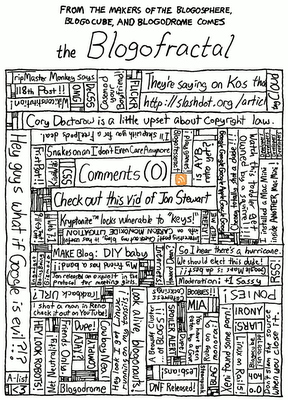
Mapping The Blogosphere

[From the wonderful xkcd: A Webcomic of Romance, Sarcasm, Math and Language.]

Thursday, July 20, 2006

In The Name Of Spam

A dead-end spamvertising site found its way here four times last night to offer me variations on the following message:

Hi Blogger, I found your blog quite informative. I just came across your blog and wanted to drop you a note telling you how impressed I was with it. I give you my best wishes for your future endeavors. If you have a moment, please visit my adventures site. Have a great week!
A WHOIS search for the guilty party didn't offer much help. From the home page of Mr. Adventure Man's domain registrar:
Did you know that for each domain name you register, anyone - anywhere, anytime - can find out your name, home address, phone number and email address?

The law requires that the personal information you provide with every domain you register be made public in the "WHOIS" database. Your identity becomes instantly available - and vulnerable - to spammers, scammers, prying eyes and worse.

But now there's a solution: [REGISTRAR NAME.]
I'll be moderating comments from here on out.

Wednesday, July 19, 2006

Video Encoding: YouTube Beats Google Video

YouTube seems to use a much crisper codec than Google Video. I have run several animated clips through both of them and there is always a notable difference in quality, and always in YouTube's favor. I'm a big fan of most of Google's recent projects, and think they have a better model for long-term viability. (Ever wondered what will happen to all of your YouTube videos if the company burns out? Or to the embedded YouTube videos in blogs and websites?) But I can't handle the compression level.

Here's a sample clip uploaded to both sites. It's a three-slide PowerPoint that intends to communicate the effects of supply and demand on price to seventh-graders (the image of the sun in the background relates to its inclusion in a teaching unit on nuclear energy). In keeping with the goal of minimizing onscreen text, there are pauses (including a few-second pause at the beginning) for instructors to explain to students what they are seeing.

YouTube Version


Google Video Version


I haven't experimented exhaustively with this - no live action, for example - but the difference seems clear. I guess this would be Reason #11 for some people. Google is also having problems with image rendering in its Picasa Web Albums, currently in "Test" mode, which I blogged about previously here, here, and here.

If I Had Three Wishes...


Julian Hector's "Mythlandia" would soon be a theme park. His beautiful 4x8' poster, which combines Greek mythology, literary figures of mythological stature, and both early (Paul Bunyan) and late (Superman, Blind Justice) American folk legends, can be explored on his website. [Via Drawn.]


On his own website, Hector credits Jaro Hess' "Land of Make Believe" as the inspiration for his own scene. Hess' painting, which features 60 scenes from children's stories, won an award at the Chicago World's Fair in 1933 in the Children's Literature Division. You can view a full (but small) picture of that painting here and purchase a reproduction, and can view detailed (but incomplete) images here.

There are at least a few direct nods in Hector's work to Hess' - the beanstalk from Jack and the Beanstalk travels up and off the page in both, for example. The two images make for interesting comparisons both in style and in tone.